
Artificial intelligence (AI) is changing the way people work, create content, and run businesses. Today, you don’t need to be a professional programmer or technology expert to start using AI to earn money online. With the right tools, basic skills, and a practical strategy, beginners can explore different ways to turn AI into an income opportunity.
Whether you’re a student, freelancer, blogger, content creator, or someone looking for a side hustle, AI tools can help you work more efficiently and develop services or products that people are willing to pay for.
But here’s the important part: AI won’t make you money automatically. You need to use it to solve real problems, create something valuable, or help businesses achieve their goals.
In this practical guide, you’ll discover how to make money with AI as a beginner, which AI tools you can start with, and how to build your first AI-powered income stream without spending a lot of money.
What Does Making Money With AI Mean?
Making money with AI means using artificial intelligence tools to create products, provide services, improve productivity, or build an online business.
For example, you can use AI to help write blog posts, generate image concepts, create social media content, design digital products, edit videos, or automate repetitive business tasks.
Instead of spending hours completing every task manually, AI can help you produce an initial draft or explore multiple ideas quickly. You can then improve the results using your own creativity, knowledge, and judgment.
Here are a few examples of how people can use AI to earn money:
- Create and sell AI-assisted content writing services.
- Design social media posts and YouTube thumbnails.
- Sell digital products such as ebooks, templates, and prompt collections.
- Start a blog and monetize it through advertising and affiliate marketing.
- Create educational videos using AI-assisted research and editing.
- Help small businesses improve their content and marketing workflows.
- Build simple websites, chatbots, or automation systems.
You don’t need to try every opportunity. The best approach is to choose one method that matches your interests and learn how to do it well.
1. Start an AI Content Writing Business
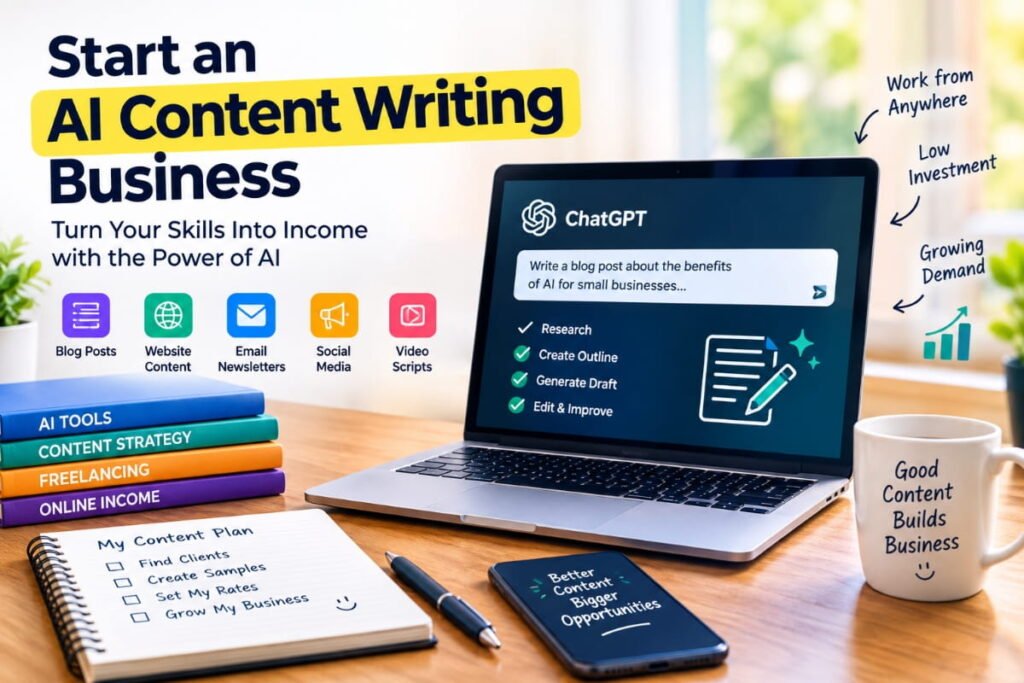
AI-assisted content writing is one of the most accessible ways for beginners to explore online freelancing.
Businesses, bloggers, and website owners regularly need content to attract customers, explain their products, and communicate with their audiences.
You can use AI writing tools to assist with research, brainstorming, outlining, and drafting. Your job is to turn that initial output into accurate, useful, and engaging content.
What Can You Create?
You can offer services such as:
- SEO blog posts and articles
- Website content
- Product descriptions
- Email newsletters
- Social media captions
- YouTube video scripts
- Advertising copy
- Frequently asked questions for business websites
For example, a local fitness trainer might need 12 social media posts every month. You could use AI to brainstorm content ideas, develop captions, and suggest creative concepts before editing everything to match the trainer’s services and audience.
AI Tools You Can Use
ChatGPT: For brainstorming, outlines, first drafts, and editing assistance.
Google Gemini: For writing assistance, idea generation, and research support.
Grammarly: For checking grammar, spelling, and clarity.
You can explore the free options before deciding whether a paid subscription is necessary.
How to Get Your First Client
Step 1: Choose a specific writing service, such as SEO blog writing for small businesses.
Step 2: Create three high-quality sample articles for your portfolio.
Step 3: Publish your samples on a simple portfolio website or document.
Step 4: Contact relevant businesses, bloggers, or marketing agencies with a personalized offer.
Step 5: Start with a small project, deliver quality work, and request feedback.
Remember that clients pay for useful content, not simply for access to an AI tool. Fact-checking, originality, and understanding the client’s audience are essential.
2. Make Money With AI Image Generation

If you enjoy visual creativity, AI image generation can help you explore design-related services.
AI image tools can generate concepts for portraits, product imagery, illustrations, backgrounds, and promotional graphics. With additional editing, these outputs can become useful assets for creators and businesses.
AI Image Services You Can Offer
You could create:
- YouTube thumbnails
- Social media graphics
- Blog featured images
- Product promotion visuals
- Posters and invitations
- Creative profile pictures
- Digital illustrations
- Advertising concepts
For example, a blogger might need a featured image for an article about healthy eating. You can use an image-generation tool to create a suitable concept, refine the composition, and prepare the final image in the required dimensions.
20 Gemini AI Photo Editing Prompts for Realistic Portraits (2026)
Useful AI Design Tools
- Canva: For designing social media graphics, presentations, and promotional materials.
- Adobe Firefly: For AI-assisted creative design and image editing.
- ChatGPT: For generating image ideas and writing detailed image prompts.
Always check the current licensing and commercial-use terms of the tools you choose.
How to Get Started
- Pick a specific design niche, such as blog featured images.
- Create five to ten portfolio samples.
- Show how your designs solve a real problem for a particular audience.
- Offer your service to bloggers, YouTubers, or small businesses.
- Improve your work based on client feedback.
Pro tip: Don’t compete only on generating images. Learn composition, typography, color selection, and basic editing. These skills can help you deliver more professional results.
3. Sell AI Prompts Online
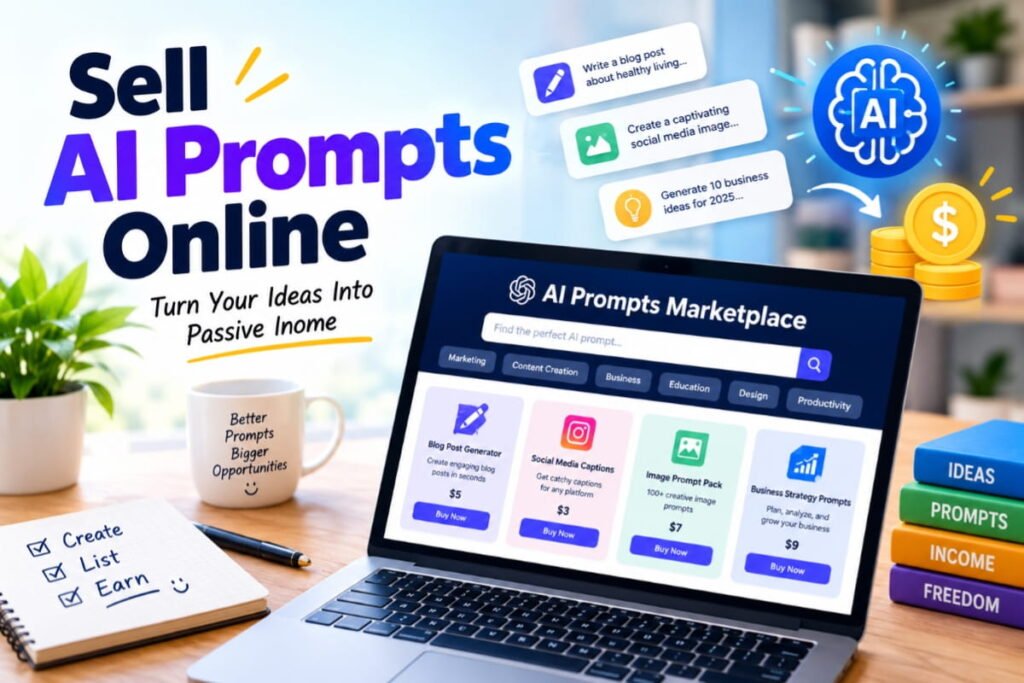
If you enjoy experimenting with AI tools, selling prompt collections may be worth exploring.
An AI prompt is an instruction that tells an AI system what to do. A well-designed prompt can help users achieve a specific result more consistently.
People may want prompts for photography, image editing, marketing, writing, business planning, education, or productivity.
Examples of AI Prompt Products
You could create:
- 100 AI photo editing prompts
- ChatGPT prompts for small business owners
- AI prompts for YouTube creators
- Prompts for professional headshots
- SEO content planning prompts
- AI prompts for students and teachers
- Product photography prompt collections
- Prompts for social media marketing
For example, you could develop a digital product called 50 AI Photo Editing Prompts for Professional-Looking Pictures.
Each prompt should include a clear instruction, its intended use, and an example of the expected result where appropriate.
Where Can You Sell AI Prompts?
Depending on their current policies and your location, you can explore:
- Your own website
- Digital product marketplaces
- Creator storefront platforms
- Relevant online communities that permit promotion
You can also publish useful free prompts on your blog to attract readers and introduce them to your paid collections.
How to Create a Prompt Ebook
Step 1: Choose one specific audience.
For example, focus on photographers, students, bloggers, or small business owners.
Step 2: Research common problems.
Find out what your target audience wants to accomplish with AI.
Step 3: Write and test your prompts.
Don’t simply generate a large collection of repetitive instructions. Test the prompts, improve unclear wording, and explain how to use them.
Step 4: Organize the prompts.
Group them into useful categories and include an introduction, examples, and practical tips.
Step 5: Create and publish your product.
You can use a document editor and a design tool to create a polished PDF ebook. Check the requirements of your chosen marketplace before publishing.
The main challenge is differentiation. Generic prompt collections are easy to reproduce, so focus on a specific problem and provide clear value.
4. Start an AI-Powered Blog
Blogging can be a long-term way to build an online business using AI tools.
You can create a website around a topic you understand, publish useful articles, attract search traffic, and monetize your audience through appropriate revenue streams.
For example, a blog about AI tools and prompts could publish tutorials, comparisons, prompt collections, and practical guides for beginners.
How AI Can Help With Blogging
AI can assist you with:
- Generating blog topic ideas
- Creating article outlines
- Developing examples
- Improving grammar and readability
- Brainstorming headlines
- Creating image concepts
- Repurposing content for social media
- Organizing content calendars
However, avoid publishing unedited AI-generated articles at scale. Readers need accurate information, original insights, and content that answers their questions better than competing pages.
Ways to Monetize a Blog
1. Display advertising
You may earn advertising revenue when your website qualifies for an advertising program, such as Google AdSense, and complies with its policies.
2. Affiliate marketing
You can recommend relevant AI software or services through affiliate programs. If a reader makes a qualifying purchase through your affiliate link, you may receive a commission under that program’s terms.
3. Sell digital products
Create ebooks, prompt packs, templates, or educational resources that solve a specific problem.
4. Offer services
Use your blog to attract clients who need content writing, AI image design, or AI workflow assistance.
5. Sponsored content
As your audience grows, relevant companies may be interested in sponsoring content on your website. Sponsored relationships should be disclosed appropriately.
A Practical Blogging Strategy
Start with one niche and build a collection of genuinely useful articles.
For example, an AI-focused website could publish content around:
- AI photo editing prompts
- ChatGPT prompts for different professions
- Beginner-friendly AI tools
- Tutorials for creating AI images
- AI productivity tips
- Digital product creation with AI
Use keyword research to understand search intent, but prioritize usefulness and originality over publishing articles simply to target keywords.
Blogging usually requires patience. Search traffic and revenue are not guaranteed, and results can take time.
5. Create YouTube Videos With AI Assistance

YouTube can be another opportunity for people who enjoy teaching, storytelling, or creating educational content.
You don’t necessarily need expensive recording equipment to begin. Depending on your topic, you can create screen recordings, tutorials, narrated presentations, or videos demonstrating how AI tools work.
Video Ideas for Beginners
Consider creating videos about:
- How to use ChatGPT for everyday tasks
- Best AI prompts for photo editing
- AI tools for students
- How to create images with AI
- Beginner tutorials for AI software
- AI tools for small businesses
- Comparisons of different AI applications
How AI Can Help
You can use AI to brainstorm video topics, structure scripts, develop titles, and plan scenes.
Video editing software can help you add captions, remove unnecessary pauses, and organize footage.
Nevertheless, your videos should offer something valuable beyond automated narration or recycled information. Demonstrations, original commentary, useful examples, and clear explanations can make your content more engaging.
How Can You Earn Money?
Potential revenue streams include:
- YouTube advertising, if you qualify for monetization
- Affiliate commissions
- Sponsorships
- Selling digital products
- Offering related services
- Directing viewers to your website
YouTube monetization requirements and policies can change, so check the current rules before building your business around advertising revenue.
Don’t expect immediate earnings. Growing an audience requires consistent publishing and content that people want to watch.
6. Offer AI Social Media Management Services
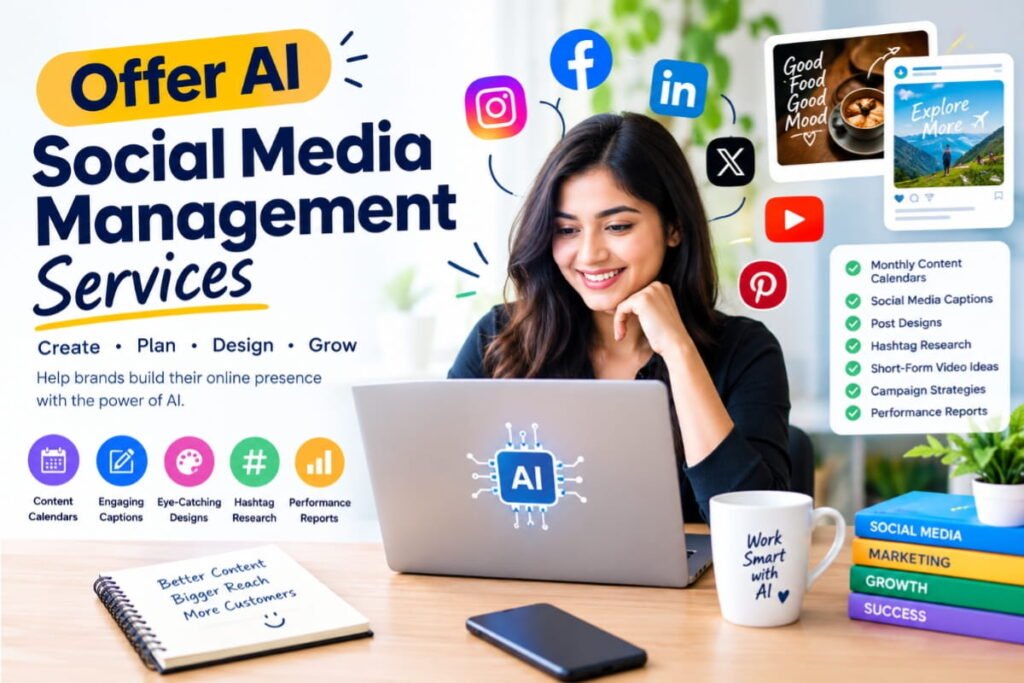
Many small businesses want to maintain an active social media presence but struggle to create content consistently.
You can help by combining AI-assisted planning with your own editing, design, and understanding of the business.
What Services Can You Provide?
Your service packages might include:
- Monthly content calendars
- Social media captions
- Post designs
- Hashtag research
- Short-form video concepts
- Promotional campaign ideas
- Content repurposing
- Basic performance reports
For example, a restaurant might need a month’s worth of promotional posts featuring its menu, special offers, and customer experience.
You can use AI to brainstorm post ideas, prepare draft captions, and plan content themes. Then customize everything using the restaurant’s actual information, brand voice, and images.
How to Find Clients
Start with a specific type of business, such as restaurants, fitness studios, salons, or local retailers.
Prepare a sample content calendar and a few sample posts for your portfolio. Then contact businesses with a personalized message explaining how your service could help.
Avoid promising viral growth or guaranteed sales. Instead, offer clear deliverables and agree on how success will be measured.
7. Sell AI-Generated Digital Products
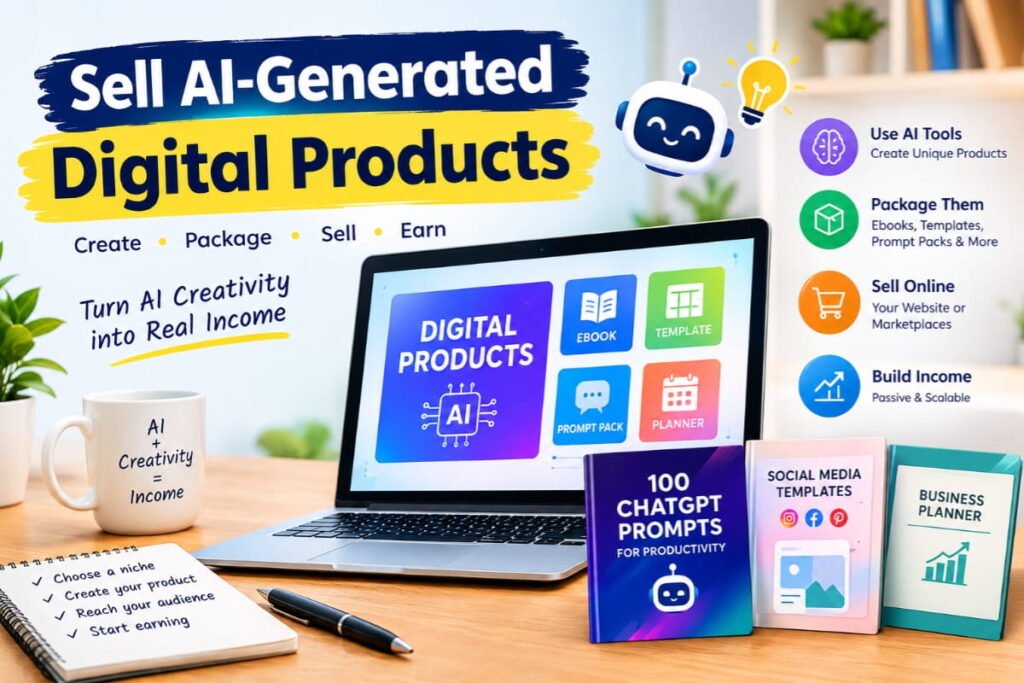
Digital products can be attractive because you can create a product once and sell additional copies without manufacturing physical inventory.
However, sales are not automatic. You still need to create a valuable product, reach potential customers, and provide support when necessary.
Digital Products You Can Create
Here are some beginner-friendly ideas:
| Digital Product | Target Audience | Example |
|---|---|---|
| Prompt ebooks | AI beginners | 100 ChatGPT Prompts for Productivity |
| Design templates | Content creators | Social Media Post Templates |
| Business planners | Entrepreneurs | Small Business Content Planner |
| Study resources | Students | AI-Assisted Study Planner |
| Content calendars | Bloggers | 30-Day Blog Planning Template |
| Checklists | Freelancers | AI Content Quality Checklist |
| Educational guides | Beginners | Getting Started With AI Tools |
You can use AI to help brainstorm, draft, and organize your product. Your own expertise should shape the final material.
How to Launch Your First Product
- Identify a specific problem.
- Research whether people are looking for a solution.
- Create a small product that solves that problem.
- Test it with a few potential users.
- Improve it using their feedback.
- Publish it on your website or a suitable marketplace.
- Promote it through useful content and relevant channels.
For a website focused on AI prompts, a specialized prompt ebook may be a natural first product.
For instance, you could create a beginner’s guide to AI photo editing with categorized prompts, practical examples, and instructions for getting better results.
Before selling any AI-assisted product, review the relevant platform rules, licensing terms, and intellectual property requirements.
8. Provide AI Services to Small Businesses
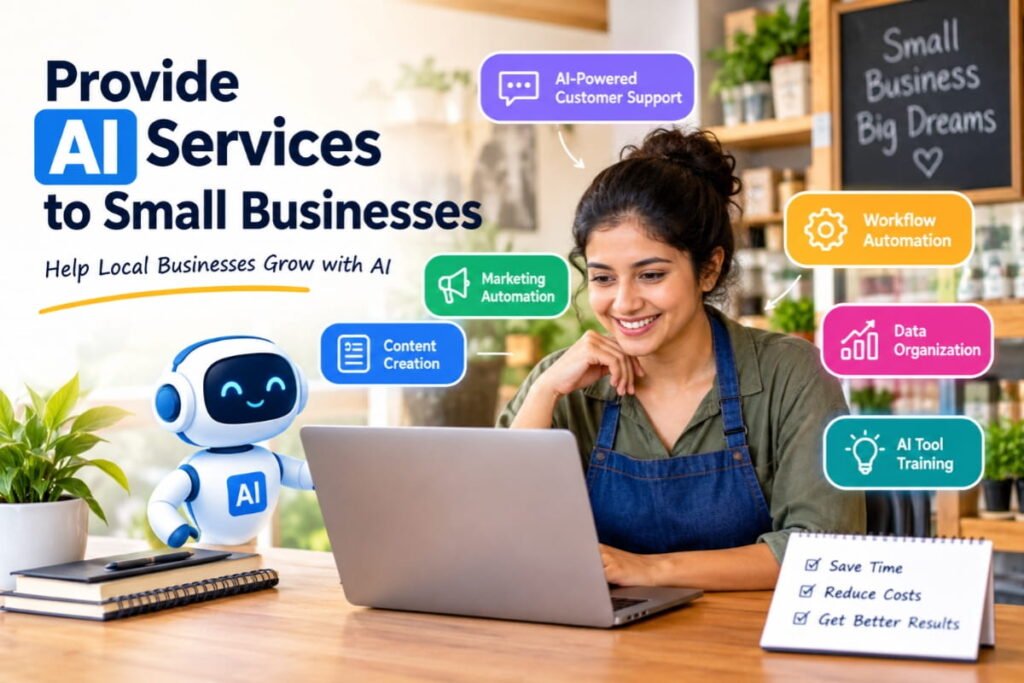
If you enjoy solving problems and learning new tools, you could help small businesses use AI more effectively.
Many businesses don’t need complicated AI systems. They may simply need help improving repetitive tasks, organizing information, or responding to common customer questions.
Services You Could Explore
- AI-assisted customer support workflows
- FAQ development
- Basic chatbot setup
- Email response templates
- Appointment inquiry workflows
- Document organization
- Marketing workflow automation
- AI tool training for employees
For example, a small service business may receive the same questions repeatedly about pricing, opening hours, or appointment availability.
You could help the business organize approved answers and configure a suitable support workflow.
Start with simple projects you understand. Test any automation carefully, especially when it interacts with customers or business data.
You should also consider privacy, data security, human review, and the possibility of incorrect AI responses.
This path may require more learning than content writing or basic design, but it can develop into a specialized service business.
9. Earn Money by Teaching People How to Use AI

If you become confident using AI tools, you can teach others how to use them effectively.
You don’t have to be an AI researcher. You can focus on practical skills that you understand and can demonstrate clearly.
What Can You Teach?
- Basic ChatGPT usage
- AI image generation
- Prompt writing
- AI tools for students
- AI-assisted content creation
- AI productivity workflows
- AI tools for small business owners
- Beginner-friendly digital product creation
You could create tutorials, workshops, ebooks, short courses, or one-to-one training sessions.
For example, a beginner’s workshop might demonstrate how to use AI to plan a week’s worth of social media content.
Your teaching should include real demonstrations, clear instructions, and honest explanations of the limitations of each tool.
Avoid presenting yourself as an expert in areas where you lack the necessary experience. Start with a topic you know well and expand as your skills improve.
10. Try AI-Assisted Freelancing Platforms
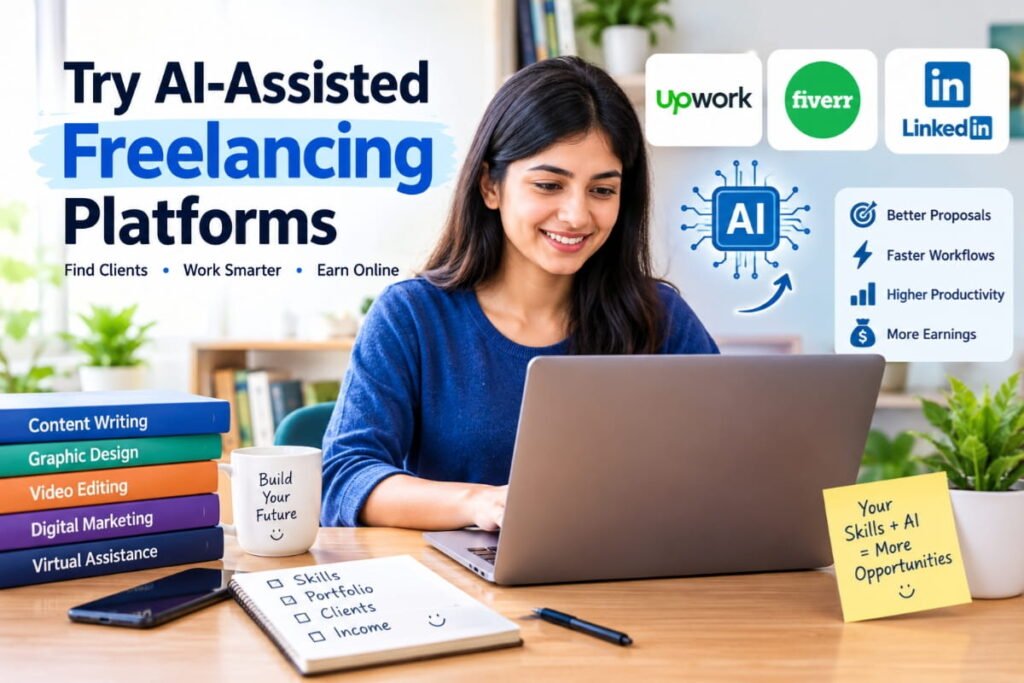
Freelancing platforms can help you discover clients who need services that AI can support.
Depending on your skills, you can explore opportunities involving writing, design, research, video editing, marketing, or virtual assistance.
Some platforms also list specialized work involving AI evaluation or data annotation. Availability, eligibility, assessments, and payment terms vary.
Platforms to Explore
- Upwork: Explore freelance projects across writing, design, marketing, and technical services.
- Fiverr: Consider packaging a clearly defined service for potential buyers.
- LinkedIn: Build professional connections and share examples of your work.
You can visit these platforms‘ official websites to review their current requirements and available opportunities.
Tips for Getting Started
Build a portfolio first. Three excellent examples are more useful than a profile that lists dozens of skills you haven’t demonstrated.
Choose a narrow service. For example, offer blog featured images rather than advertising yourself as an expert in every type of design.
Personalize your proposals. Explain how you would address the client’s specific problem.
Deliver reliable work. Meet deadlines, communicate clearly, and revise deliverables according to the agreed terms.
Keep learning. Use client feedback to improve your skills and service quality.
AI can help you work faster, but clients still expect accuracy, reliability, and professional communication.
Which AI Tools Should Beginners Use?
You don’t need to subscribe to every AI application. Start with a small collection of tools that support your chosen income method.
Here are some options to explore:
| AI Tool | Main Use | Suitable For |
|---|---|---|
| ChatGPT | Writing, brainstorming, planning, and problem-solving | Writers, bloggers, freelancers |
| Google Gemini | Writing assistance and idea generation | Students, creators, professionals |
| Canva | Graphic design and visual content | Designers, bloggers, social media managers |
| Adobe Firefly | AI-assisted image creation and editing | Designers and visual creators |
| Grammarly | Grammar, spelling, and writing clarity | Writers and professionals |
| CapCut | Video editing and short-form content production | Video creators and social media managers |
Tool features, free usage limits, and commercial licensing can change. Check the official terms before relying on a particular feature for paid work.
The smartest approach is to learn one or two tools well instead of constantly switching between new applications.
How Much Money Can You Make With AI?
Your earnings depend on the service you provide, the quality of your work, your experience, your pricing, and your ability to find customers.
There is no universal income figure for beginners, and using AI does not guarantee that you will earn money.
For a practical starting point, consider the following illustrative examples:
| Income Method | Example Offer | How You Could Earn |
|---|---|---|
| Content writing | One edited blog article | Charge per article |
| Graphic design | A set of social media graphics | Charge per design package |
| Prompt ebooks | A specialized prompt collection | Sell individual copies |
| Social media management | Monthly content creation | Charge a monthly fee |
| Blogging | Helpful articles in a focused niche | Advertising, affiliates, or products |
| YouTube | Original educational videos | Eligible monetization and related products |
| AI consulting | A defined workflow improvement | Charge per project or service agreement |
These are business models, not income guarantees. Your first month could produce no revenue while you learn and build your portfolio.
A Simple Example of Freelance Income
Imagine you offer a content service and eventually secure four clients who each pay ₹3,000 for an agreed package.
Your monthly revenue would be:
4 clients × ₹3,000 = ₹12,000.
This is only a hypothetical example, not a prediction of what a beginner will earn.
Your actual profit would depend on expenses such as software, internet access, platform fees, taxes, and the time needed to complete the work.
Focus first on delivering a service people value. Once you have evidence of demand, you can improve your pricing and develop a more sustainable business.
A 30-Day Plan to Start Making Money With AI
If you’re new to AI, following a simple plan can help you avoid wasting time trying too many things at once.
Here is a beginner-friendly roadmap.
Week 1: Choose One Skill
Spend the first week exploring AI tools and selecting a service or product.
Choose one of these starting points:
- AI-assisted content writing
- AI image design
- Prompt ebook creation
- Social media content services
- AI-assisted video editing
Pick a method that matches your interests and available time.
Learn the basic workflow and create several practice projects.
Week 2: Build Your Portfolio
Use the second week to create three to five strong examples.
If you’re a writer, prepare sample articles.
If you’re a designer, create sample graphics.
If you’re creating digital products, develop a small prototype and test it with potential users.
Focus on quality rather than quantity.
Week 3: Publish and Find Potential Customers
Create a simple portfolio page or professional profile.
Start reaching out to relevant businesses or clients. You can also publish useful content related to your chosen niche.
For example, a designer could share before-and-after examples, while a writer could publish a practical guide demonstrating their expertise.
Your goal is to discover whether people are interested in your offer.
Week 4: Improve Your Offer
Review the responses you receive.
Which samples attracted attention? Which questions did potential clients ask? Was your offer clear?
Use this information to improve your portfolio, pricing, and service description.
If you secure a client, deliver the agreed work professionally. If you don’t, refine your offer and continue testing.
Your goal for the first 30 days should be to build a marketable skill, create a portfolio, and start conversations with potential customers—not to expect a guaranteed income.
Common Mistakes to Avoid When Making Money With AI
AI can make some tasks easier, but beginners can lose time and money by approaching it incorrectly.
Here are several mistakes to avoid.
1. Expecting Instant Income
AI is not a magic money-making machine. You still need to learn, create useful work, and find customers.
Be cautious of anyone promising guaranteed earnings with little or no effort.
2. Using AI Without Checking the Results
AI systems can produce inaccurate facts, misleading explanations, and unnatural writing.
Review every deliverable before publishing it or sending it to a client.
3. Trying Every AI Business Idea
Switching between blogging, freelancing, video creation, and digital products can prevent you from developing any one skill.
Start with one method and evaluate your progress before expanding.
4. Ignoring Copyright and Licensing
Not every AI-generated image, text, or design can automatically be used in every commercial context.
Check the relevant tool’s terms, avoid unauthorized use of copyrighted material, and respect marketplace rules.
5. Spending Too Much on Tools and Courses
You can often test an idea with free tools before investing money.
Avoid buying expensive subscriptions or courses until you understand what you need and why.
6. Publishing Low-Quality Content at Scale
Producing hundreds of generic articles or social posts does not guarantee traffic, sales, or audience growth.
Prioritize originality, usefulness, and accuracy.
7. Ignoring Customer Needs
A technically impressive AI output is not necessarily valuable to a customer.
Understand the problem your customer wants solved and design your service around that outcome.
Frequently Asked Questions (FAQs)
1. Can I make money with AI as a complete beginner?
Yes, beginners can use AI to support services such as content writing, graphic design, video editing, social media management, and digital product creation. However, earning money requires learning useful skills, producing quality work, and finding customers.
2. Can I make money with AI for free?
You can start exploring AI income opportunities using free tools and a basic internet connection. Some tools have usage limits, and you may eventually need paid software, depending on your work. You can reduce your initial costs by testing demand before investing.
3. What is the easiest way to make money with AI?
The easiest option depends on your existing skills. If you enjoy writing, try AI-assisted content services. If you enjoy design, experiment with AI image creation and graphic design. If you prefer creating products, consider a specialized prompt ebook or template collection.
No method guarantees quick results.
4. Do I need coding skills to make money with AI?
No. Many beginner-friendly opportunities, including writing, design, blogging, and social media content creation, do not require programming. Coding can open additional opportunities in software development and automation, but it isn’t essential for every AI business.
5. Can students make money with AI?
Students can explore AI-assisted freelancing, educational content, design services, and digital products around their studies. Choose work that fits your schedule and complies with applicable platform requirements.
6. How can I make money with ChatGPT?
You can use ChatGPT to help brainstorm content, draft articles, develop marketing ideas, organize research, prepare templates, or plan digital products. You can then offer a related service or sell a useful product after reviewing and improving the output.
ChatGPT itself does not guarantee income.
7. Can AI help me earn passive income?
AI can help you create digital products, publish educational content, or develop other assets that may continue generating revenue after publication. However, these businesses usually require upfront work and ongoing promotion, updates, and customer support. Passive income is never guaranteed.
8. Is making money with AI legitimate?
Yes, using AI to provide real services or create useful products can be a legitimate business activity. However, scams exist. Be cautious of schemes that promise guaranteed returns, demand large upfront payments for supposed earning access, or refuse to explain how the business actually generates revenue.
9. Can I make money with AI in India?
Yes. Depending on your skills and customer base, you can explore freelance services, digital products, blogging, educational content, and other AI-assisted businesses. You should review local tax obligations, platform eligibility, payment options, and applicable commercial-use terms.
10. How long does it take to earn money using AI?
There is no fixed timeline. A freelancer may find a client relatively quickly, while a blog or YouTube channel may take much longer to build an audience. The time required depends on your chosen method, work quality, demand, and marketing efforts.
Final Thoughts
Making money with AI as a beginner is less about finding a magical tool and more about learning how to create something people genuinely value.
You can start with content writing, image design, social media management, prompt ebooks, blogging, or another service that matches your interests.
Choose one method, learn the necessary tools, build a portfolio, and test your offer with potential customers. Improve your work based on feedback instead of expecting immediate results.
If you already enjoy experimenting with AI prompts, creating digital products or offering AI-assisted creative services could be a natural starting point.
Start small, focus on quality, and treat AI as a tool that helps you work more effectively—not as a substitute for skill, effort, or business judgment.
Keep exploring practical AI tutorials, creative prompts, and beginner-friendly tools on AI Prompt Dekho to discover new ways to use artificial intelligence in your work and everyday life.