Have you ever read a textbook chapter several times but still struggled to understand the concept? Whether it is a complicated math formula, a difficult science topic, a historical event, or a challenging programming concept, learning something new can sometimes feel overwhelming.
That is where ChatGPT can help.
ChatGPT is an AI-powered tool that can explain complex ideas in simple language, provide examples, create practice questions, and help you study more effectively. With the right prompts, you can turn difficult lessons into understandable explanations and make your study sessions more productive.
In this guide, we will explore 25 useful ChatGPT prompts for students to understand difficult topics, improve their learning skills, prepare for exams, and build confidence in their studies.
Why Should Students Use ChatGPT to Understand Difficult Topics?
Every student learns differently. Some understand concepts through examples, while others prefer visual explanations, step-by-step solutions, or real-world applications.
ChatGPT can help you explore a topic in different ways until it makes sense to you.
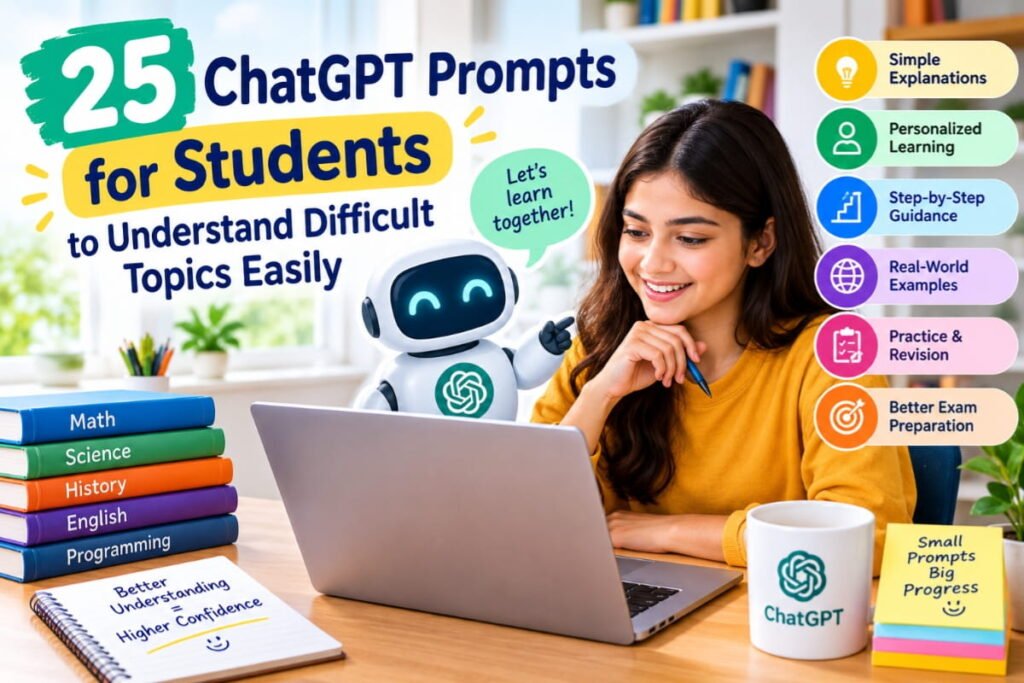
Here are some benefits of using ChatGPT for learning:
- Simple explanations: Understand complicated concepts using everyday language.
- Personalized learning: Adjust explanations to your grade level and knowledge.
- Step-by-step guidance: Break difficult problems into smaller, manageable steps.
- Real-world examples: Connect theoretical concepts to practical situations.
- Practice and revision: Generate quizzes, flashcards, and revision notes.
- Better exam preparation: Identify knowledge gaps and practice challenging questions.
Remember that ChatGPT is a learning assistant, not a replacement for textbooks, teachers, or reliable academic sources. Always verify important facts, formulas, and answers.
Students can also consult the official ChatGPT FAQ to learn more about the tool and its capabilities.
25 Best ChatGPT Prompts for Students to Understand Difficult Topics
Copy any of the following prompts into ChatGPT, replace the text in brackets with your topic, and start learning.
1. Explain a Difficult Topic in Simple Language
Sometimes, textbook explanations contain technical terms that make a topic harder to understand. This prompt helps you learn the basics first.
ChatGPT Prompt:
“Explain [topic name] in very simple language, as if I am a beginner. Avoid complicated jargon and use everyday words. Break the explanation into small sections and provide one easy example to help me understand the main concept.”
Best for: Science, mathematics, economics, history, and other challenging subjects.
2. Explain a Topic Like I Am 10 Years Old
When a concept feels too complicated, imagine learning it as a child would. This approach encourages simple explanations and familiar examples.
ChatGPT Prompt:
“Explain [topic name] as if I were 10 years old. Use simple words, relatable examples, and an easy-to-follow explanation. Avoid unnecessary technical terms, but make sure the explanation is accurate.”
Best for: Abstract concepts, scientific theories, and unfamiliar terminology.
3. Break a Complex Topic into Step-by-Step Lessons
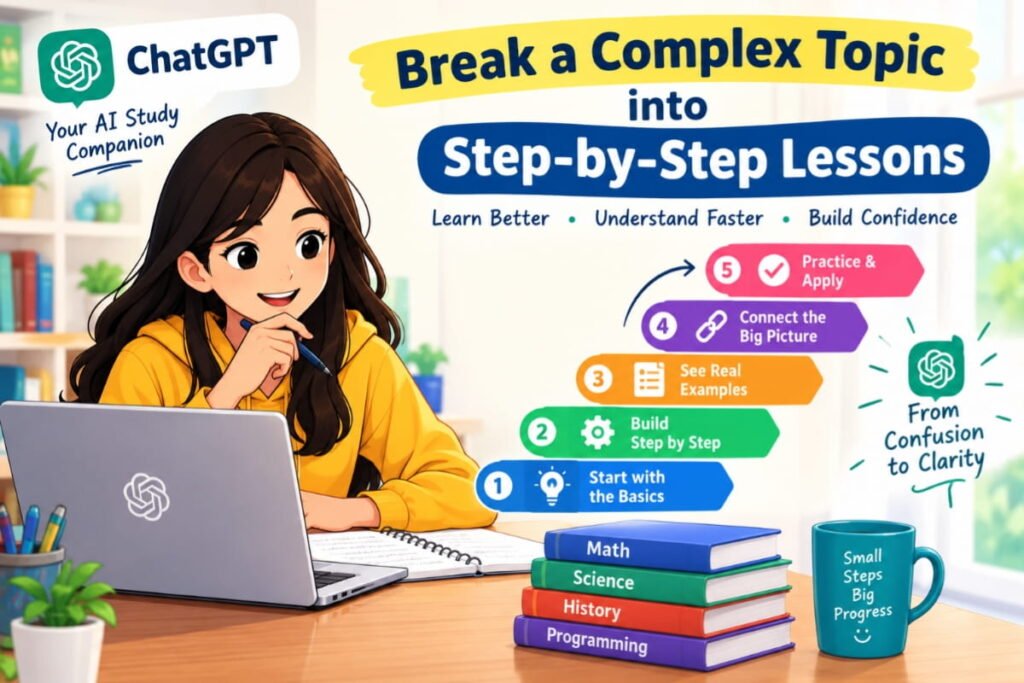
Large topics can feel overwhelming when you try to learn everything at once. This prompt divides a difficult concept into smaller lessons.
ChatGPT Prompt:
“Break down [topic name] into 5 small, easy-to-understand steps. Explain each step separately, starting with the basics and gradually moving toward advanced ideas. Include a short example after each step and explain how the steps connect.”
Best for: Calculus, physics, chemistry, programming, and complex academic chapters.
4. Understand a Topic Through Real-Life Examples
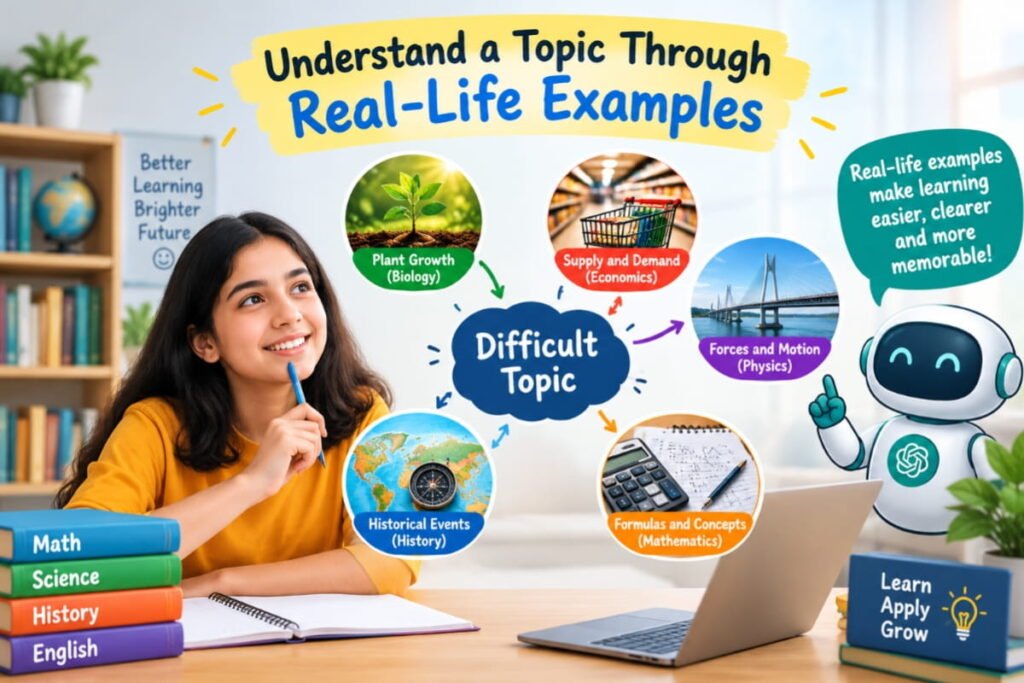
Real-life examples make abstract ideas easier to remember because they connect learning with everyday experiences.
ChatGPT Prompt:
“Explain [topic name] using 5 real-life examples that I can relate to as a student. For each example, explain how it demonstrates the concept and what lesson I should learn from it.”
Best for: Economics, biology, physics, mathematics, and social sciences.
5. Use the Feynman Technique to Learn a Difficult Concept
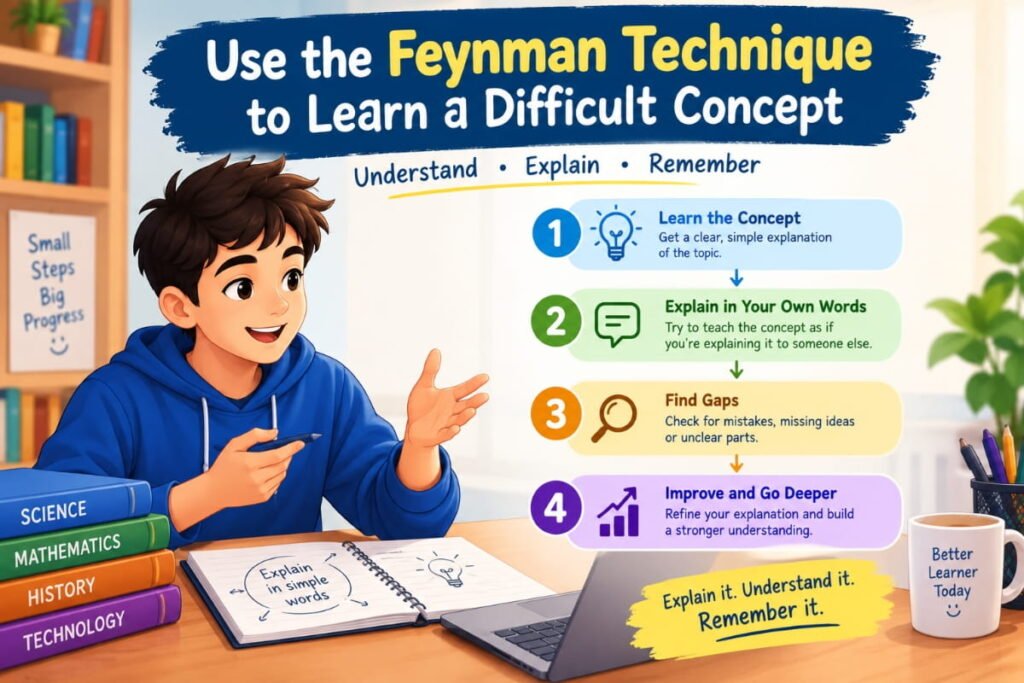
The Feynman Technique involves explaining an idea in simple language to reveal gaps in your understanding.
ChatGPT Prompt:
“Help me learn [topic name] using the Feynman Technique. First, give me a simple explanation. Then ask me to explain the concept in my own words. Review my explanation, identify any mistakes or missing ideas, and help me improve it step by step.”
Best for: Deep understanding, active learning, and long-term retention.
6. Compare Two Confusing Concepts
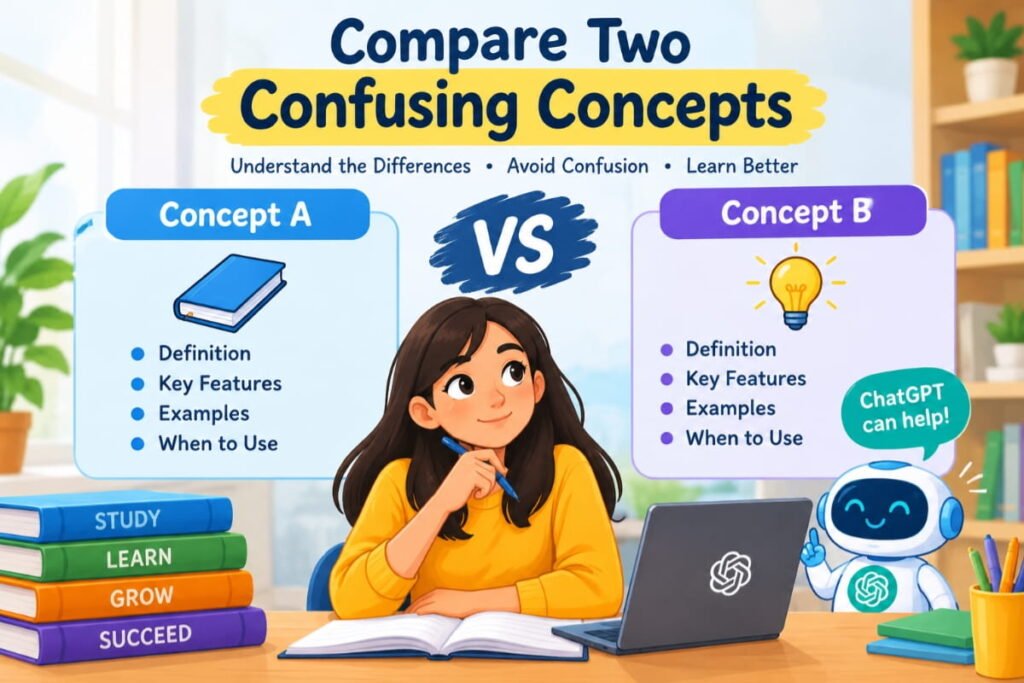
Students often confuse concepts that appear similar but have different meanings. Comparing them side by side can make the differences clearer.
ChatGPT Prompt:
“Explain the differences between [concept A] and [concept B]. Create a comparison table showing their definitions, main features, similarities, differences, and examples. Finish with a simple trick to help me remember the difference.”
Best for: Mitosis vs. meiosis, speed vs. velocity, acids vs. bases, and related concepts.
7. Explain a Difficult Mathematical Formula
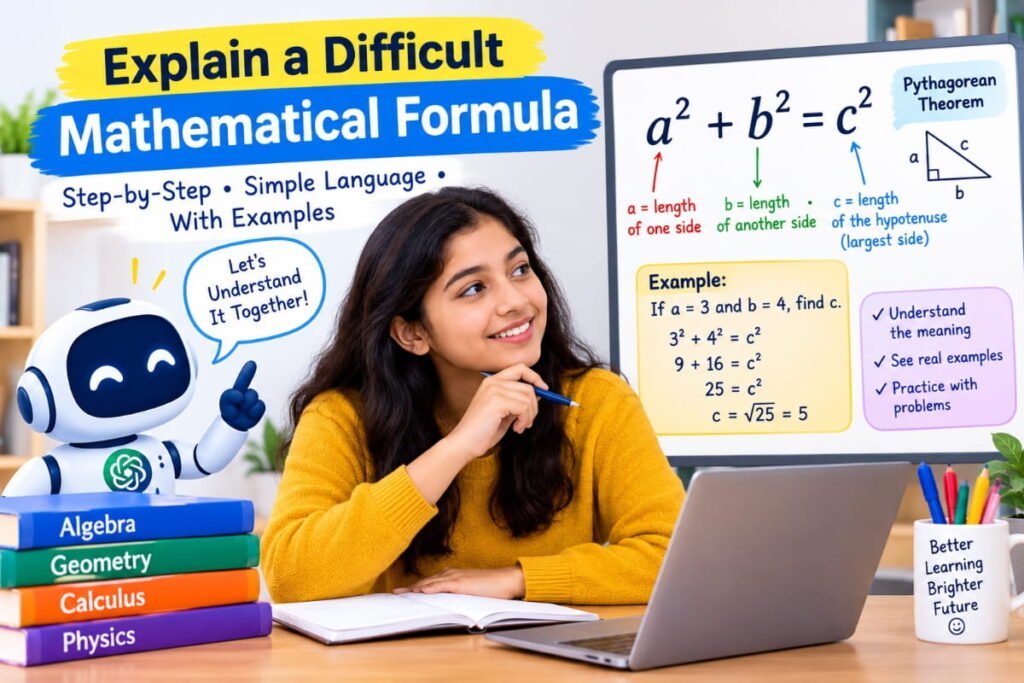
Mathematical formulas are easier to understand when you know what each symbol means and why the formula works.
ChatGPT Prompt:
“Explain the formula [formula name or formula] in simple language. Define every symbol, explain the logic behind the formula, and solve one easy example step by step. Then give me two practice problems with answers hidden until I ask for them.”
Best for: Algebra, geometry, trigonometry, statistics, and calculus.
8. Understand Science Concepts Through Analogies
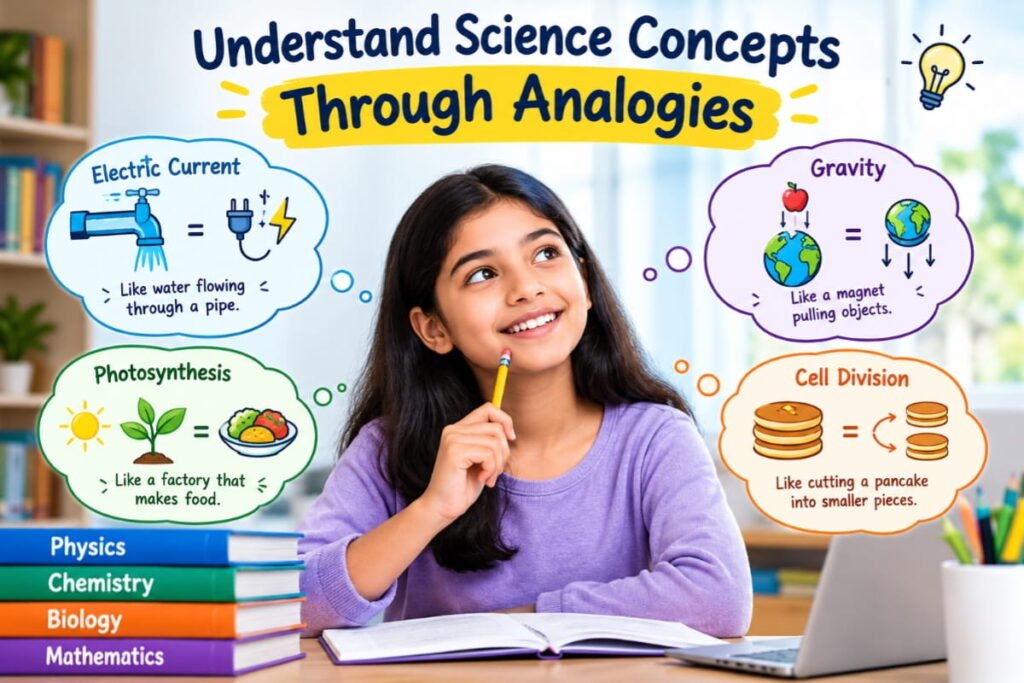
An analogy connects an unfamiliar concept with something familiar. It can make complex scientific ideas easier to visualize.
ChatGPT Prompt:
“Explain [science topic] using 3 simple analogies from everyday life. For each analogy, explain which parts of the analogy correspond to the real scientific concept. Also mention where the analogy stops being accurate.”
Best for: Electricity, atoms, gravity, photosynthesis, and chemical reactions.
9. Learn a Topic Through a Story
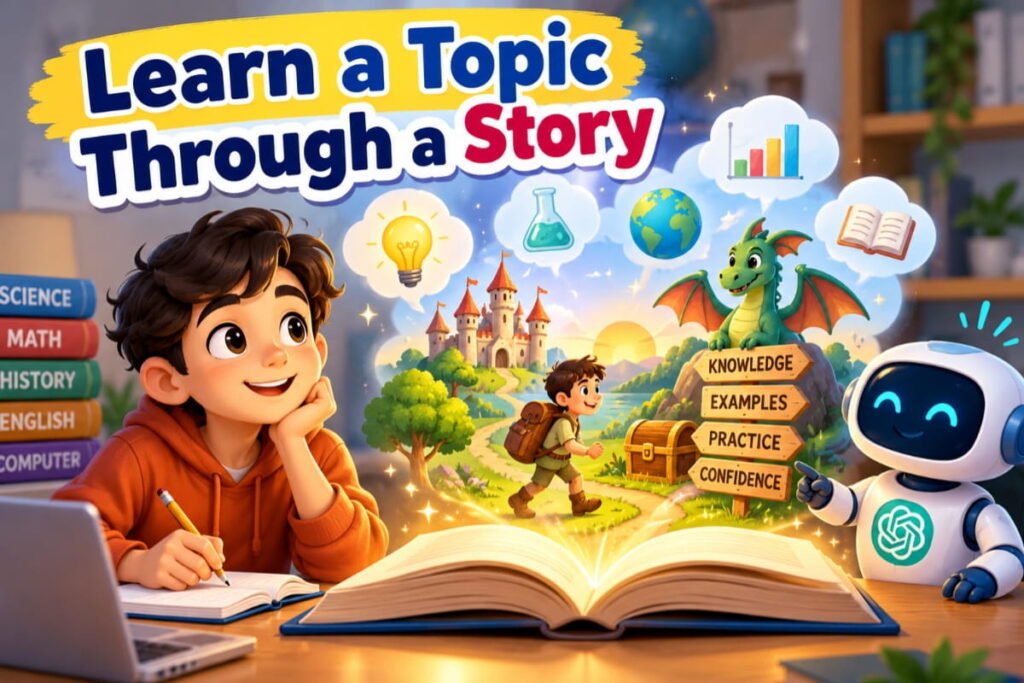
Stories can make information more engaging and help you remember how different ideas connect.
ChatGPT Prompt:
“Turn [topic name] into a short, interesting story that helps me understand its main concepts. Include the important facts, explain difficult terms naturally, and finish with a summary of the key lessons.”
Best for: History, biology, geography, and theoretical subjects.
10. Understand a Difficult Topic Using a Text-Based Diagram
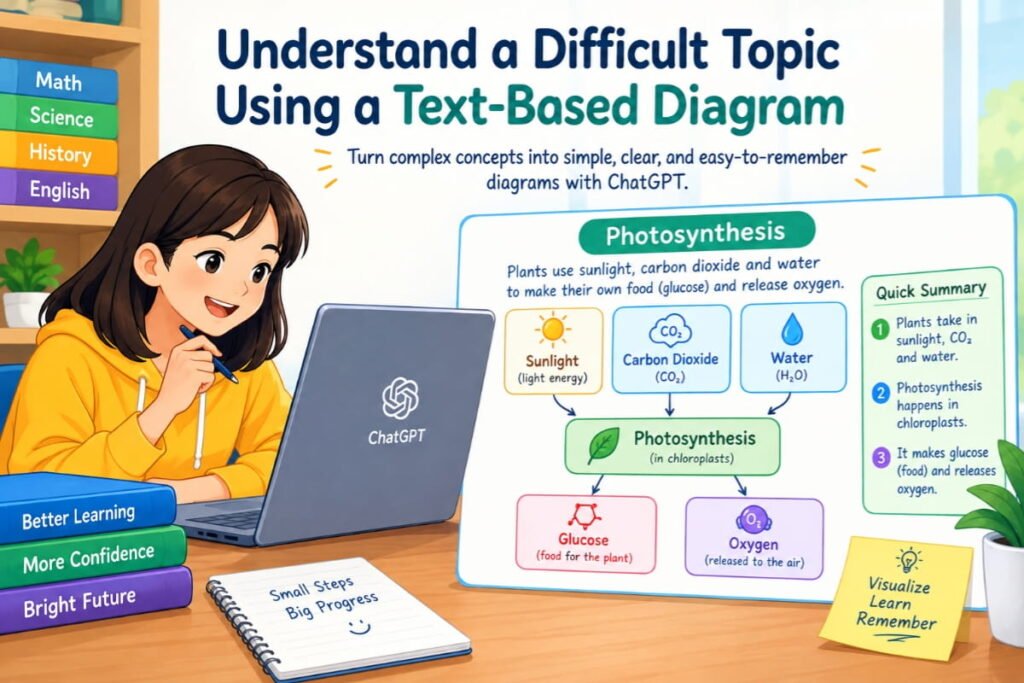
Visual organization helps students understand relationships, sequences, and systems.
ChatGPT Prompt:
“Explain [topic name] using a simple text-based diagram or flowchart. Label the important parts and explain how they connect. After the diagram, provide a step-by-step explanation of the entire process in beginner-friendly language.”
Best for: The water cycle, human digestion, computer networks, and biological processes.
11. Find the Most Important Concepts in a Chapter
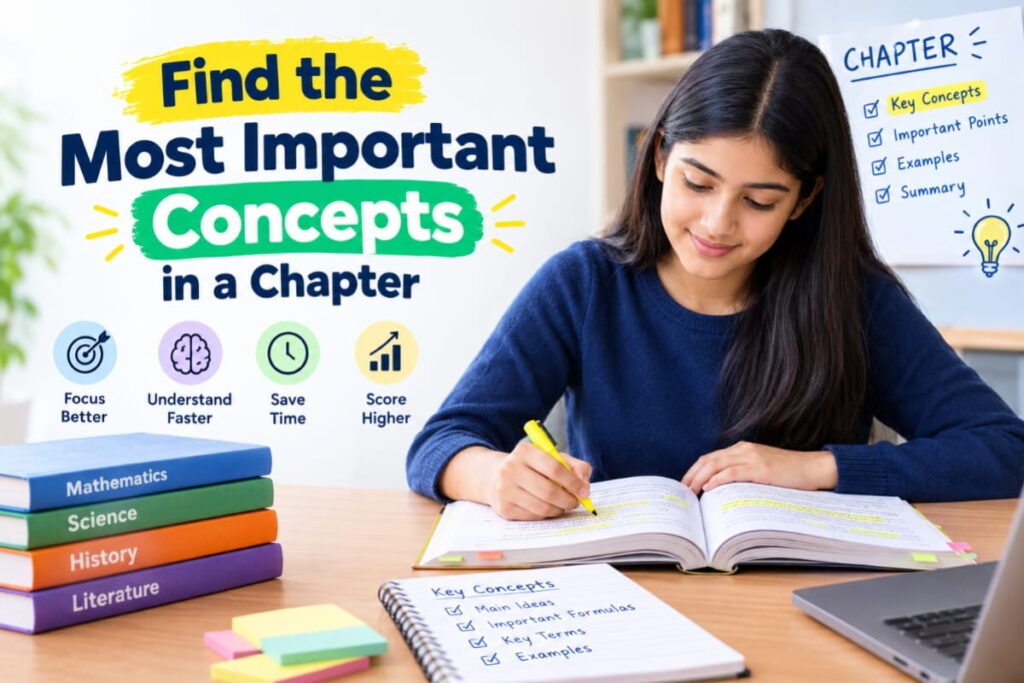
When a chapter contains too much information, identifying its central ideas makes studying more manageable.
ChatGPT Prompt:
“Analyze the topic [chapter name or subject]. Identify the 10 most important concepts I need to understand. Explain each concept in 2–3 simple sentences and show how the concepts are connected. Separate essential ideas from supporting details.”
Best for: Textbook revision, chapter summaries, and exam preparation.
12. Identify Common Misconceptions
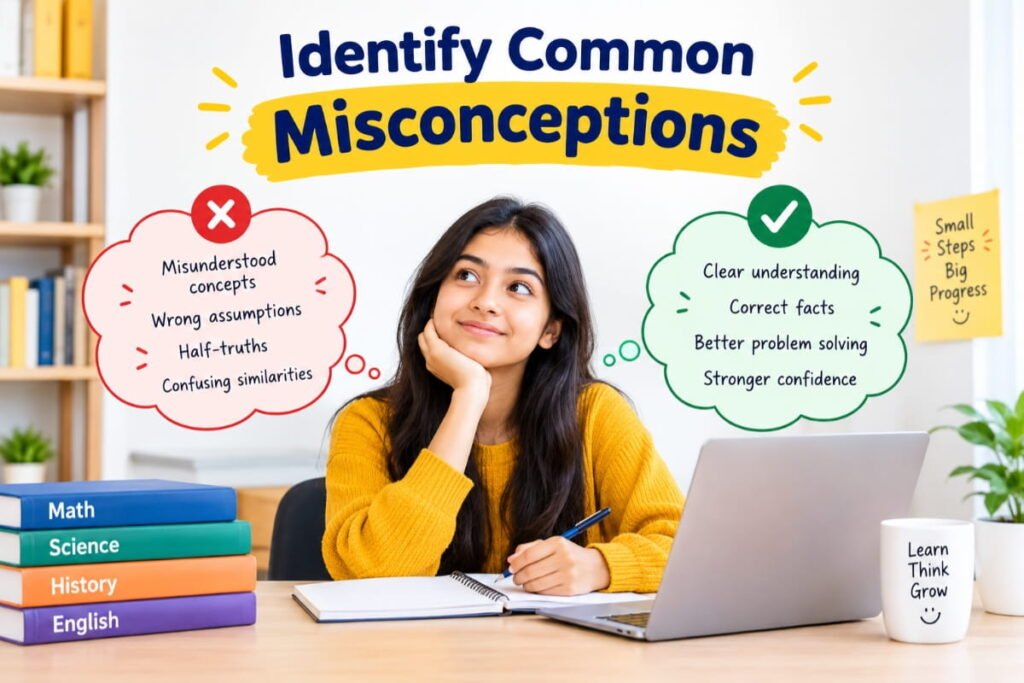
Sometimes, students believe they understand a topic but have misunderstood an important detail.
ChatGPT Prompt:
“List the 7 most common misconceptions students have about [topic name]. For each misconception, explain why it is incorrect, provide the correct understanding, and include a simple example that clears up the confusion.”
Best for: Physics, mathematics, chemistry, biology, and grammar.
13. Learn Through the Socratic Method
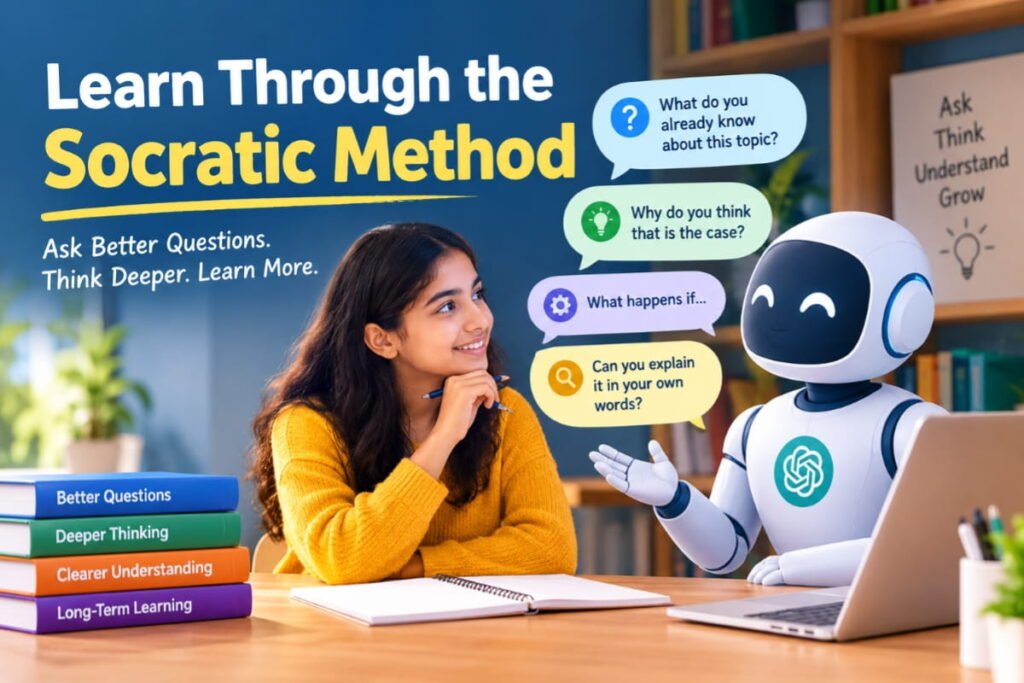
Instead of giving you all the answers immediately, ChatGPT can guide you through a series of questions that develop your reasoning skills.
ChatGPT Prompt:
“Act as a patient tutor helping me understand [topic name] through the Socratic method. Ask me one question at a time, starting with basic ideas and gradually increasing the difficulty. Do not reveal the complete answer immediately. Use hints and follow-up questions to help me discover the answer myself.”
Best for: Critical thinking, philosophy, mathematics, and conceptual learning.
14. Create a Beginner-to-Advanced Learning Path
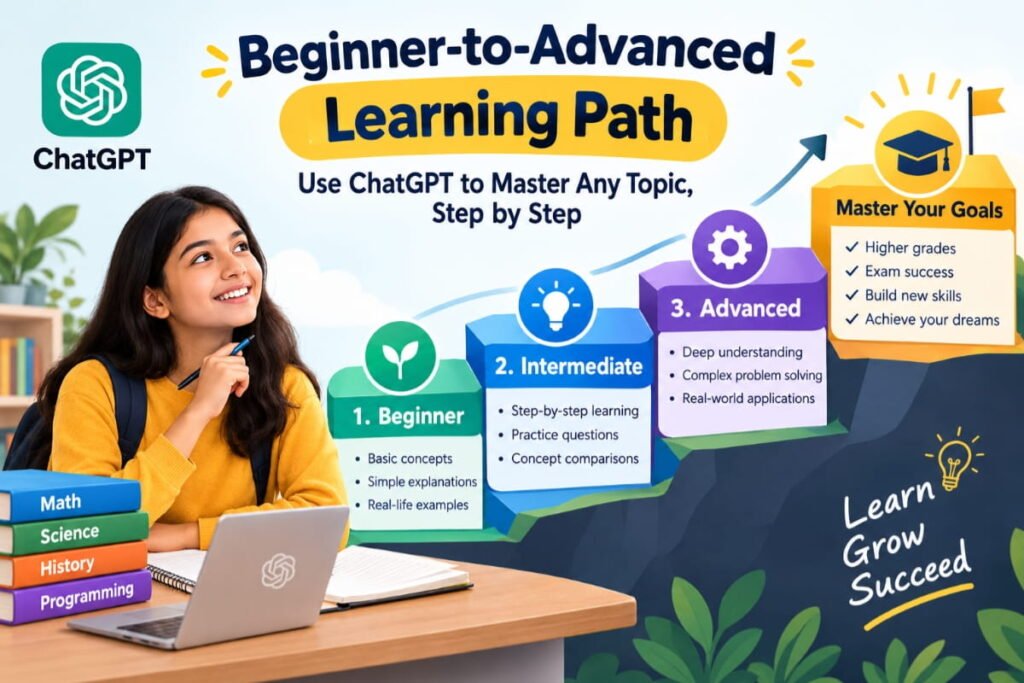
Some topics require foundational knowledge before you can understand advanced concepts.
ChatGPT Prompt:
“Create a learning roadmap for [topic name], starting from beginner level and progressing to advanced level. Divide it into stages, list the prerequisites for each stage, explain what I should learn, and give me a simple practice task after each stage.”
Best for: Programming, mathematics, artificial intelligence, and other cumulative subjects.
15. Explain a Topic Using a Comparison Table
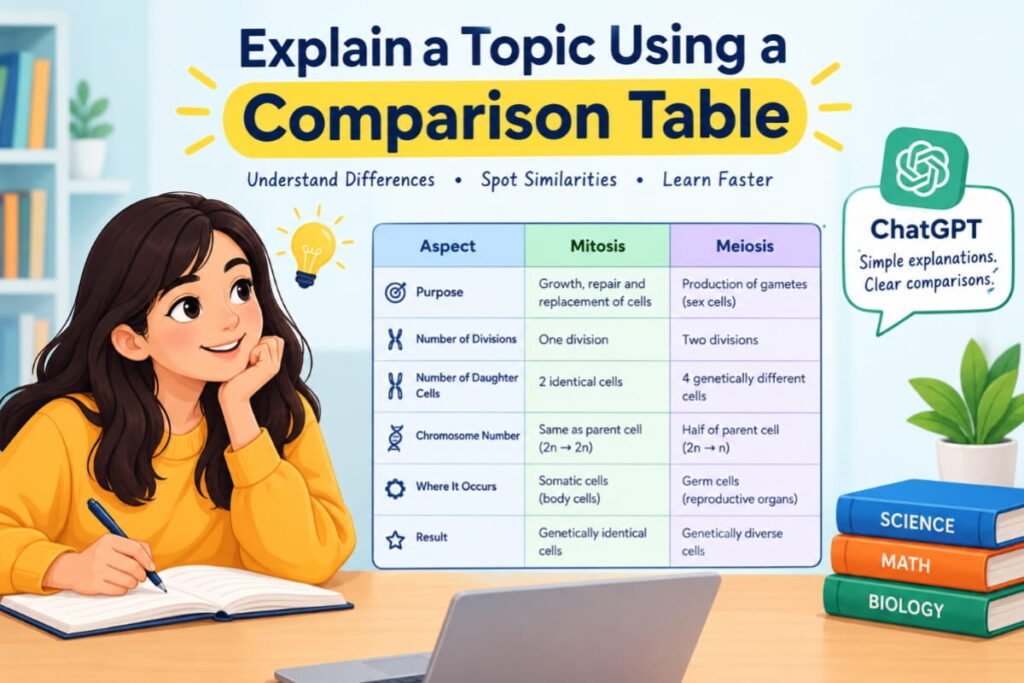
A comparison table can organize a large amount of information into a format that is easier to review.
ChatGPT Prompt:
“Create a clear comparison table explaining the main types, components, or theories related to [topic name]. Include their definitions, characteristics, uses, examples, and key differences. Add a short summary of the most important points.”
Best for: Biology classifications, literary movements, economic systems, and scientific theories.
16. Turn Difficult Notes into Easy Study Notes

Dense class notes can be difficult to revise quickly. This prompt helps simplify the language while preserving essential information.
ChatGPT Prompt:
“Rewrite the following study notes about [topic name] in clear, student-friendly language. Organize the information under headings and bullet points. Define technical terms, highlight important facts, and include examples where necessary. Preserve the original meaning and flag anything that appears unclear or potentially incorrect.
My notes: [Paste your notes here]”
Best for: Lecture notes, textbook extracts, and last-minute revision.
17. Generate Practice Questions with Explanations
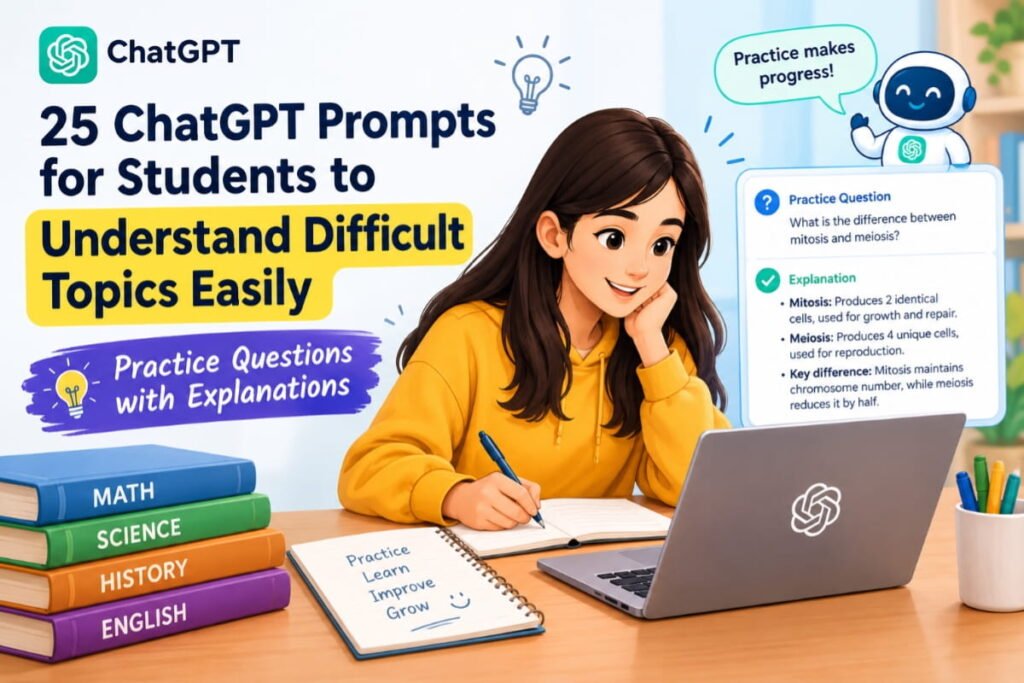
Practice questions help you check whether you can apply a concept rather than simply recognize it.
To strengthen your learning, explore retrieval practice strategies that encourage you to recall information instead of simply rereading your notes.
ChatGPT Prompt:
“Create 10 practice questions on [topic name], starting with easy questions and progressing to challenging ones. Mix multiple-choice, short-answer, and application-based questions. Let me answer before revealing the solutions, then explain why each correct answer is right.”
Best for: Self-assessment, homework practice, and exam revision.
18. Understand Why I Got a Question Wrong
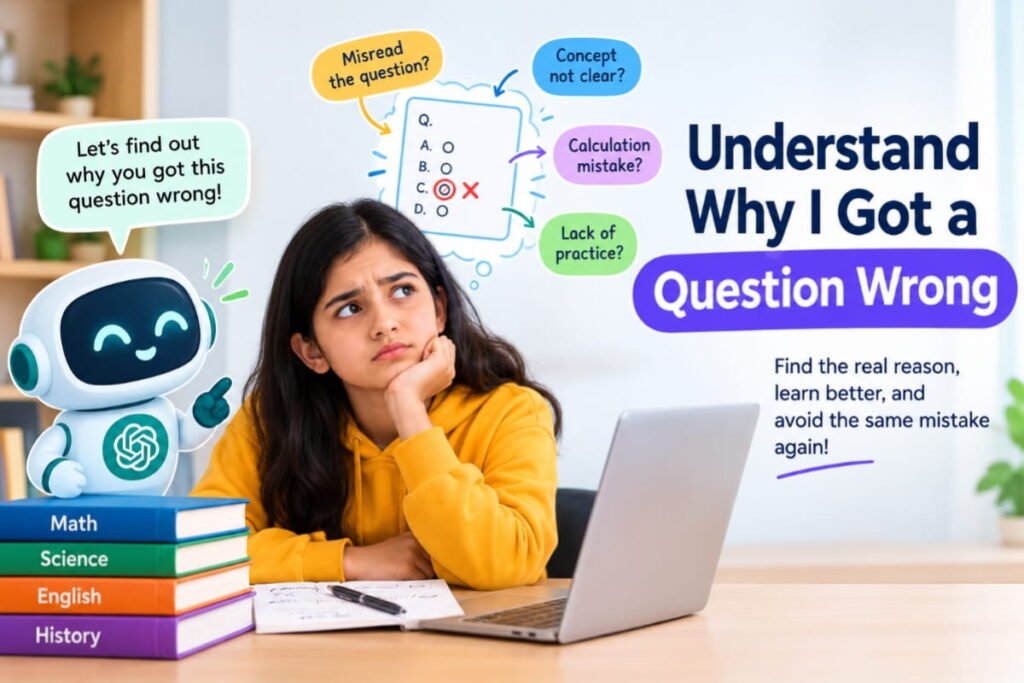
Mistakes can reveal exactly which part of a concept needs more attention.
ChatGPT Prompt:
“I attempted this question: [paste question]. My answer was [paste your answer], but the correct answer is [correct answer, if known]. Explain where my reasoning went wrong, identify the concept I misunderstood, and show me how to solve the question correctly. Then give me a similar question to practice.”
Best for: Mathematics, physics, chemistry, and analytical subjects.
19.Create Flashcards for Difficult Concepts
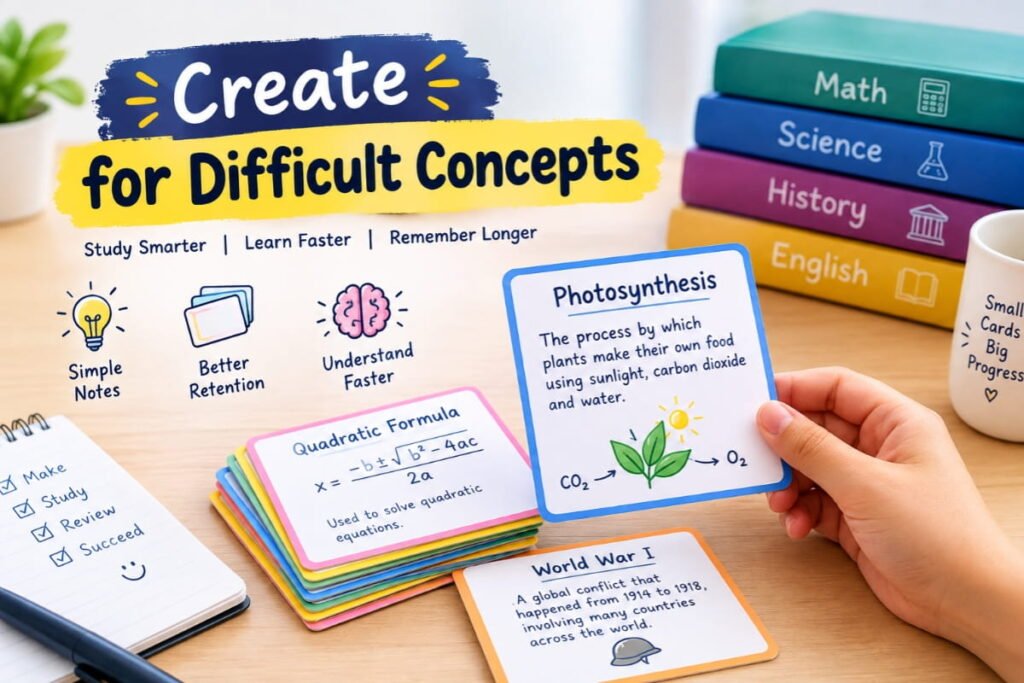
Flashcards support active recall, a study technique in which you retrieve information from memory instead of simply rereading it.
ChatGPT Prompt:
“Create 15 study flashcards for [topic name]. Put one clear question on the front and a concise, accurate answer on the back. Include definitions, key facts, formulas, common mistakes, and application-based questions. Format them so I can easily copy them into a flashcard app.”
Best for: Vocabulary, formulas, scientific terms, and memorization-heavy subjects.
20. Explain a Topic Through a Practical Problem
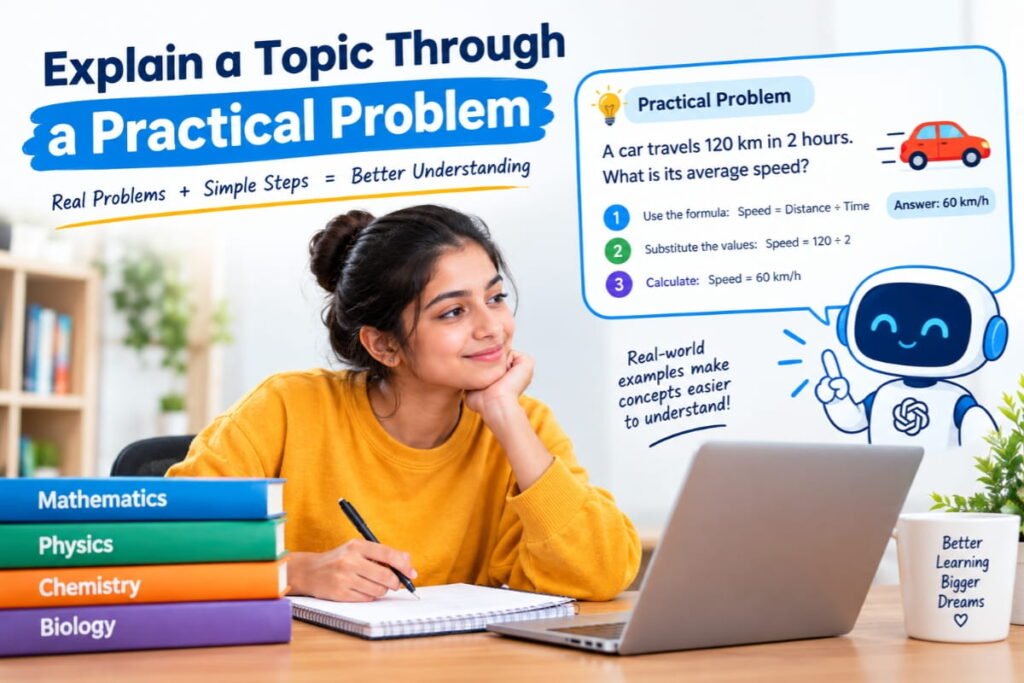
Applying a concept to a realistic problem helps you understand when and how to use it.
ChatGPT Prompt:
“Teach me [topic name] by giving me a realistic problem that requires using the concept. Let me attempt the solution first. Then explain the correct approach step by step, show why each step matters, and give me a second problem with a slightly higher difficulty level.”
Best for: Mathematics, physics, computer science, business, and economics.
21. Understand Difficult Programming Concepts
Programming concepts can be confusing when definitions are not accompanied by working examples.
ChatGPT Prompt:
“Explain [programming concept] to a beginner using simple language. Show a short code example in [programming language], explain each line, describe the expected output, and identify common beginner mistakes. Then give me a small coding exercise to test my understanding.”
Best for: Python, Java, JavaScript, data structures, and algorithms.
22. Prepare for Exams with Concept-Based Revision
Memorizing answers without understanding the underlying concepts can make unfamiliar exam questions difficult.
ChatGPT Prompt:
“Help me prepare for an exam on [subject or chapter]. Identify the core concepts I should understand, explain each one briefly, and create a revision checklist. Then quiz me with questions that test understanding and application rather than memorization alone.”
Best for: School exams, college assessments, and competitive examination preparation.
23. Connect Different Concepts Together
Understanding how ideas relate to one another creates a stronger foundation than learning isolated facts.
ChatGPT Prompt:
“Explain how [concept A], [concept B], and [concept C] are connected. Start by defining each concept, then show their relationships using a simple concept map or numbered explanation. Give me an example that demonstrates how all three work together.”
Best for: Interdisciplinary topics, advanced science, economics, and computer science.
24. Find the Gaps in My Understanding
A student may know the definitions of a topic but struggle to apply them. This prompt helps uncover those gaps.
ChatGPT Prompt:
“Act as my personal tutor for [topic name]. Assess my understanding by asking 5 questions of increasing difficulty, one at a time. After each answer, identify what I understand correctly and what I need to improve. At the end, create a personalized study plan based on my mistakes.”
Best for: Personalized learning, exam preparation, and identifying weak areas.
25. Master Any Difficult Topic with a Complete Learning Session
This final prompt combines explanations, examples, practice, and feedback into one structured learning session.
ChatGPT Prompt:
“Act as an expert, patient tutor and help me master [topic name]. My current level is [beginner/intermediate/advanced], and my goal is [understand the concept/prepare for an exam/solve difficult problems].
Follow these steps:
- Explain the topic in simple language.
- Identify the key concepts and prerequisites.
- Provide real-life examples and useful analogies.
- Break difficult parts into manageable steps.
- Highlight common misconceptions.
- Ask me practice questions one at a time.
- Review my answers and explain my mistakes.
- Give me a final quiz to check my understanding.
- Summarize the most important lessons.
- Recommend what I should study next.
Adapt your explanations to my answers and do not move to advanced material until I understand the fundamentals.”
Best for: Any difficult subject that requires structured, personalized learning.
How to Get Better Results from ChatGPT as a Student
Using a good prompt is only the beginning. The way you interact with ChatGPT also affects how much you learn.
1. Mention Your Class or Knowledge Level
Instead of asking, “Explain quantum physics,” try asking, “Explain the basic principles of quantum physics to a Class 11 student who has studied introductory mechanics.”
This helps ChatGPT adjust the depth and complexity of its explanation.
2. Ask Follow-Up Questions
If you do not understand the first explanation, do not simply move on. Ask questions such as:
- “Can you explain that in simpler words?”
- “Give me another example.”
- “Why does this step work?”
- “What is the difference between these two ideas?”
- “Can you explain it without using technical terms?”
Learning often requires several explanations from different angles.
3. Try Solving Problems Before Seeing the Answers
Ask ChatGPT to provide hints instead of complete solutions. Attempt the problem yourself before requesting an explanation.
This encourages independent thinking and helps you identify the areas where you need more practice.
4. Use Active Recall and Spaced Repetition
After learning a topic, close your notes and explain it from memory. Return to the topic later to test whether you still remember the key concepts.
ChatGPT can generate quizzes and flashcards to support this process, but you should actively attempt the answers yourself.
Research published in Nature Reviews Psychology reviews evidence supporting spaced practice and retrieval practice as effective learning strategies.
5. Verify Important Information
AI tools can occasionally generate incorrect facts, misleading explanations, or faulty calculations. Check important information against your textbooks, class notes, teacher’s guidance, and reliable academic resources.
For mathematical problems, verify calculations. For factual topics, confirm dates, definitions, and scientific claims.
6. Personalize Every Prompt
The more context you provide, the more useful the response can be.
For example, mention your subject, grade level, current difficulty, preferred learning style, and learning objective. You can also paste your own notes or a question you are struggling with, provided you have permission to share the material.
For additional lessons, exercises, and quizzes, students can visit Khan Academy India, which offers free learning resources aligned with the Indian curriculum.
Frequently Asked Questions (FAQs)
1. Can ChatGPT help students understand difficult topics?
Yes. ChatGPT can explain concepts in simpler language, provide examples, compare related ideas, create practice questions, and guide students through problems. However, its explanations should be checked against reliable learning materials.
2. What is the best ChatGPT prompt for studying?
A useful all-purpose prompt asks ChatGPT to act as a patient tutor, explain the topic at your level, provide examples, ask practice questions, review your answers, and identify gaps in your understanding. Prompt number 25 in this guide is a good starting point.
3. Can ChatGPT explain topics according to my class level?
Yes. Include your class, grade, course, or current knowledge level in your prompt. You can also mention the syllabus or textbook you are using so the explanation better matches your studies.
4. Is ChatGPT useful for exam preparation?
ChatGPT can help you revise concepts, create quizzes, generate flashcards, explain mistakes, and organize a study plan. For the best results, combine it with your official syllabus, past papers, textbooks, and regular independent practice.
5. Are ChatGPT prompts free to use?
You can use these prompts with ChatGPT, subject to the features and usage limits of your account. Availability of specific tools and features may vary by plan and over time.
6. Can ChatGPT replace teachers and textbooks?
No. ChatGPT can support your learning, but teachers provide educational judgment, classroom context, and personalized guidance that AI may not reproduce reliably. Textbooks and trusted academic resources remain important for accurate information.
Final Thoughts
Understanding difficult topics becomes easier when you break them into smaller concepts, explore practical examples, and test your knowledge regularly.
These 25 ChatGPT prompts for students can help you turn confusing lessons into structured learning sessions. From simple explanations and real-life analogies to practice questions and personalized tutoring, each prompt offers a different way to approach a challenging subject.
Start with the prompt that matches your current difficulty, ask follow-up questions, and practice explaining the concept in your own words. The goal is not simply to get answers from AI but to develop the knowledge and confidence to solve problems independently.
Bookmark this guide from AIPromptDekho and use these prompts whenever you encounter a difficult topic.
Happy learning!