
Artificial intelligence is no longer just for programmers or technology experts. Today, students, job seekers, small business owners, freelancers, and ordinary people can use AI tools such as ChatGPT, Google Gemini, and Claude to solve everyday problems, save time, and learn new skills.
Whether you want to prepare for a job interview, improve your English, manage a monthly budget, grow a small business, or organize your daily routine, the right AI prompt can make the task much easier.
In this guide, we have collected 50 practical AI prompts for real-life problems in India. You can copy these prompts, customize them with your own details, and use them with your preferred AI assistant.
The prompts are designed for common situations in India, including competitive exam preparation, job applications, local business marketing, household expenses, and multilingual communication.
What Is an AI Prompt?
An AI prompt is an instruction or question you give to an artificial intelligence tool to get a useful response.
For example, instead of asking:
“Help me find a job.”
You could write:
“Act as a career coach for fresh graduates in India. Help me identify five entry-level jobs based on my B.Com degree, basic Excel skills, and interest in accounting. Suggest suitable job titles, skills I should improve, and a seven-day application plan.”
The second prompt provides more context and explains exactly what you need.
A simple formula for better AI prompts:
- Role: Tell the AI which type of assistant it should act as.
- Context: Explain your situation.
- Task: Describe what you want it to do.
- Format: Specify whether you want a table, checklist, plan, or example.
You do not need to include all four elements in every prompt, but adding relevant details often improves the results.
1. AI Prompts for Job Applications and Career Growth
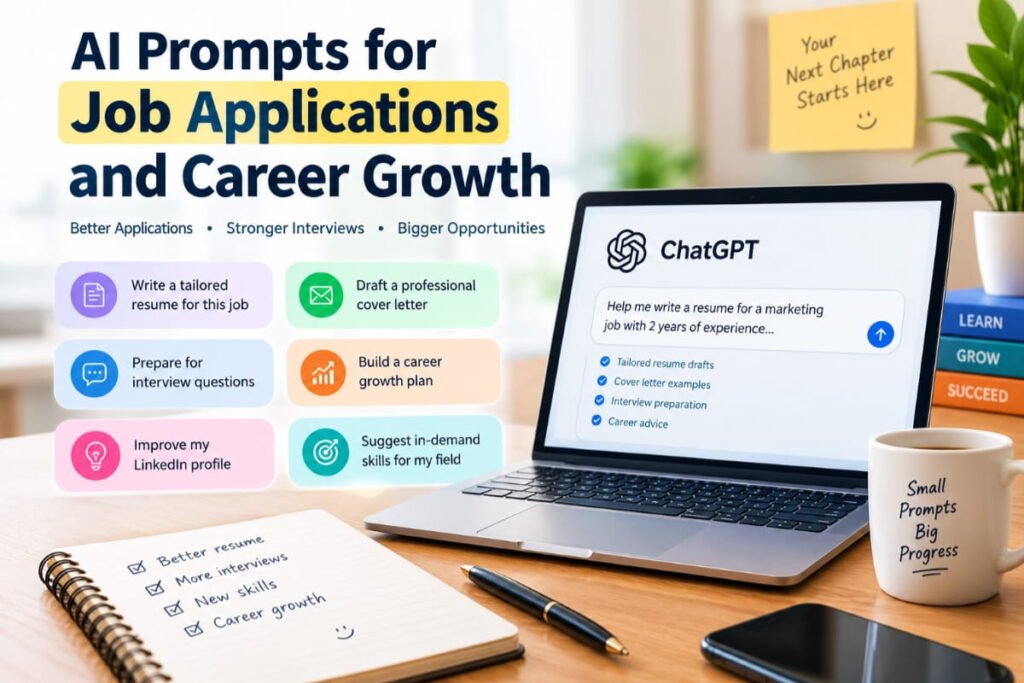
Finding a suitable job can be challenging, especially for freshers who have limited work experience. AI can help you organize your job search, improve your resume, practice interviews, and identify skills to develop.
Prompt 1: Find suitable jobs based on your qualifications
Copy this prompt:
“Act as a career guidance expert familiar with the Indian job market. My qualification is [your qualification], my skills are [your skills], and my preferred location is [city or remote]. Suggest 10 suitable job roles for me. For each role, explain the required skills, typical responsibilities, and how I can prepare for it. Clearly distinguish general career suggestions from currently verified job openings.”
Best for: Freshers, graduates, and people planning a career change.
Prompt 2: Create a professional resume
“Act as a professional resume writer. Help me create a clear, ATS-friendly resume for the position of [job title]. My education is [education], my skills are [skills], and my experience or projects are [details]. Organize my information into a professional resume format. Use relevant keywords from the job description without inventing qualifications, achievements, or work experience.”
Best for: Job seekers applying to Indian companies, multinational companies, and remote positions.
Prompt 3: Write a job application email
“Write a professional job application email for the position of [job title] at [company name]. My relevant qualifications are [details], and my strongest skills are [skills]. Keep the email concise, polite, and personalized. Include a suitable subject line and a professional closing. Do not claim that I have experience or qualifications I have not provided.”
Prompt 4: Practice job interview questions
“Act as an interviewer hiring for [job role] in India. Ask me one interview question at a time. Wait for my answer, evaluate it for clarity and relevance, and suggest a stronger answer based on my actual experience. Include technical and behavioral questions appropriate for the role.”
Prompt 5: Build a skill-development plan
“I want to become qualified for [target job] within [time period]. My current skills are [skills], and I can study for [hours] per day. Create a realistic weekly learning plan with free or low-cost learning resources, practical projects, and milestones. Prioritize skills that appear in relevant job descriptions and explain how I can demonstrate my progress.”
Practical tip: AI can help prepare job applications, but verify job vacancies, employer details, and application links independently. Never pay an unverified recruiter for a promised job.
2. AI Prompts to Improve English Speaking and Communication
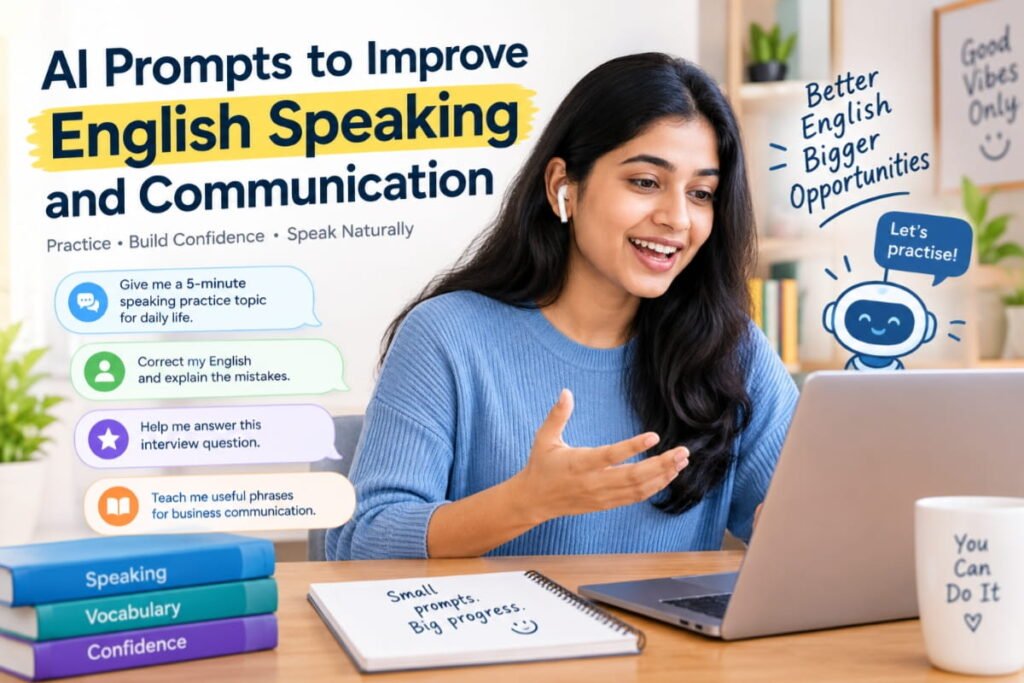
English communication can be useful for interviews, higher education, customer service, freelancing, and professional growth. AI can provide conversation practice without requiring a human partner every time.
Prompt 6: Practice everyday English
“Act as my friendly English conversation partner. My current level is [beginner/intermediate/advanced], and my first language is [language]. Start a simple conversation about everyday life. Ask one question at a time, correct my grammar gently, explain mistakes in simple words, and provide a more natural version of my answer. Gradually increase the difficulty.”
Prompt 7: Learn English through Hindi explanations
“Teach me practical English through Hindi explanations. Today, teach me 10 useful English sentences for [situation, such as shopping, travelling, or an interview]. For every sentence, provide the Hindi meaning, pronunciation guidance, a short example conversation, and a practice exercise. Use natural, everyday language.”
You can replace Hindi with Bengali, Tamil, Telugu, Kannada, Marathi, or another language you prefer.
Prompt 8: Improve English pronunciation
“Help me practice pronunciation for [English words or sentences]. Explain difficult sounds in simple language, identify likely pronunciation challenges for a speaker of [first language], and divide longer words into syllables where helpful. Give me a short daily practice routine. If you cannot hear or analyze audio in this chat, provide written pronunciation guidance instead.”
Prompt 9: Write professional emails
“Act as a professional communication coach. Rewrite the following email so it sounds clear, polite, and professional while preserving my original meaning. Explain the three most important changes and suggest a suitable subject line. Here is my draft: [paste your email].”
Prompt 10: Learn five useful English words every day
“Teach me five practical English words suitable for my current level of [level]. Choose words useful in everyday conversation or professional communication. For each word, provide its simple meaning, a Hindi translation if useful, two example sentences, common mistakes, and a short quiz. Avoid repeating words from the list I provide: [previous words].”
Practical tip: Consistent daily practice is more useful than memorizing hundreds of words without using them. Ask the AI to test you on previously learned material.
3. AI Prompts for Students and Competitive Exam Preparation
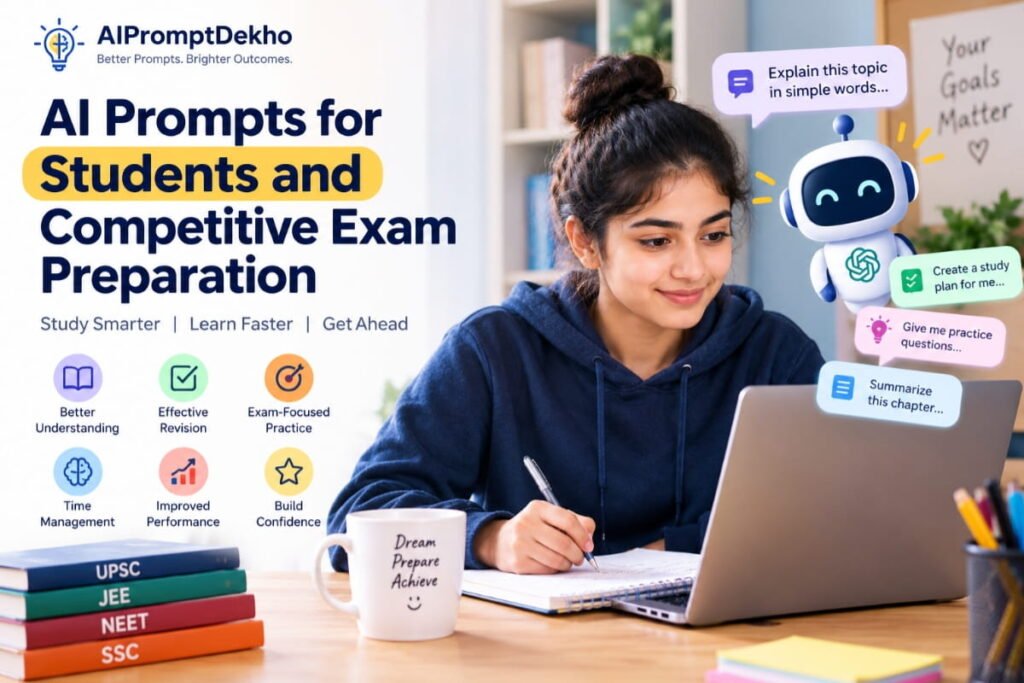
Students can use AI to understand difficult topics, create revision schedules, practice questions, and identify weak areas. These prompts work for school, college, and many competitive exam preparation routines.
Prompt 11: Create a personalized study timetable
“Act as a study planner. I am preparing for [exam or subject]. My exam date is [date], the topics I need to cover are [topics], and I can study for [hours] each day. Create a realistic daily timetable with revision, practice questions, short breaks, and weekly assessments. Give extra time to difficult topics and include buffer days for unfinished work.”
Prompt 12: Explain difficult topics simply
“Explain [topic] as if I am a beginner. Start with a simple explanation, then give a real-life example relevant to India, followed by a more detailed explanation. Identify common misconceptions and finish with five practice questions of increasing difficulty. Do not assume I already understand advanced terminology.”
Prompt 13: Generate practice questions
“Create 20 practice questions on [subject or topic] for [exam name and level]. Include multiple-choice questions, an answer key, and short explanations. Label any questions you create as practice questions, not actual previous-year exam questions. Make sure the answers are consistent with the stated syllabus and flag anything that requires verification against an official source.”
Prompt 14: Summarize study notes
“Turn the following study material into revision notes for [exam or class]. Organize the content under clear headings, define important terms, list key facts and formulas, and identify topics that may need extra practice. Preserve important qualifications and exceptions. Do not add unsupported facts. Here is the material: [paste notes].”
Prompt 15: Identify weak areas before an exam
“Act as my study coach for [subject]. Give me a 10-question diagnostic quiz, asking one question at a time. After I answer, explain the correct answer and track the concepts I struggle with during this session. At the end, summarize my weak areas and create a seven-day revision plan focused on those topics.”
Practical tip: Verify exam dates, eligibility rules, syllabi, and official notifications on the relevant examination authority’s website. Use AI-generated questions for practice, not as a substitute for official study material.
4. AI Prompts for Small Businesses in India
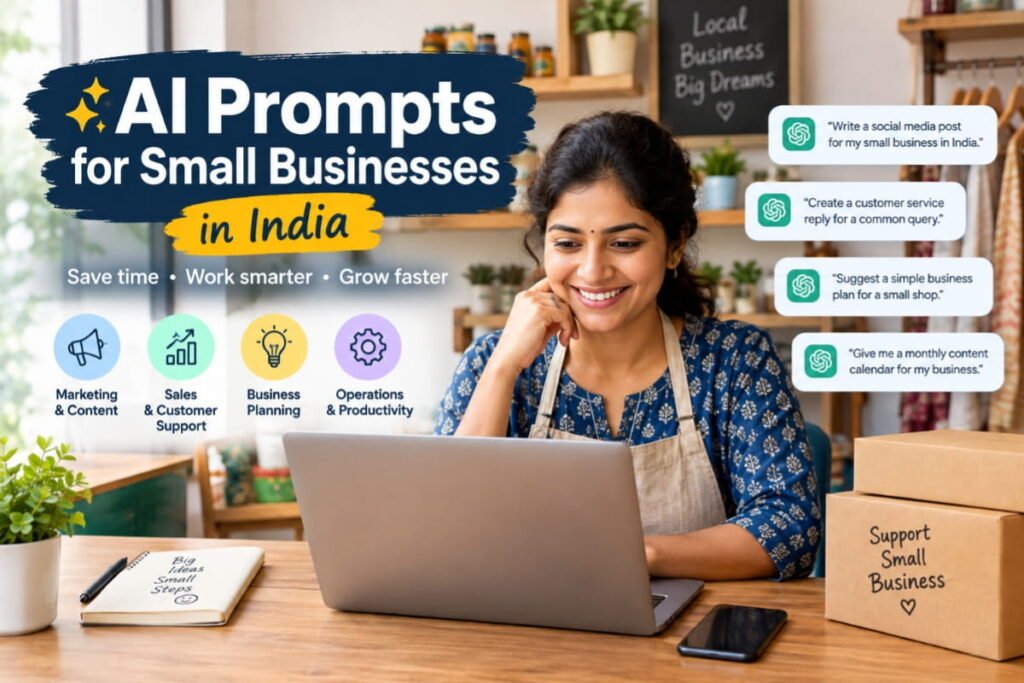
Small businesses often need to handle marketing, customer communication, product descriptions, and daily planning with limited time and resources. AI can help create first drafts and organize routine tasks.
Prompt 16: Create a marketing plan for a local shop
“Act as a practical marketing consultant for a small business in India. My business is [business type], located in [city or area], and my target customers are [customer group]. My monthly marketing budget is [amount]. Create a 30-day marketing plan using affordable channels such as WhatsApp Business, Instagram, Google Business Profile where eligible, and local partnerships. Include weekly actions, example messages, and simple ways to measure results.”
Prompt 17: Write product descriptions
“Write three product descriptions for [product name]. My target customers are [audience], the product’s verified features are [features], and the preferred tone is [tone]. Create a short version for WhatsApp, a detailed ecommerce version, and a social media caption. Do not invent product specifications, certifications, health benefits, or customer reviews.”
Prompt 18: Generate social media content ideas
“Create 30 social media content ideas for my [business type] in India. My audience is [audience], my main products or services are [details], and my goal is [brand awareness, inquiries, or sales]. Organize the ideas into educational posts, product demonstrations, customer FAQs, behind-the-scenes content, and seasonal campaigns. Include a suggested format and call to action for each idea.”
Prompt 19: Respond to customer complaints professionally
“Act as a customer service representative for my [business type]. Draft a polite response to this customer complaint: [complaint]. Acknowledge the customer’s concern, avoid blaming the customer, and suggest an appropriate next step based on the facts I provide. If information is missing, ask for it instead of promising a refund, replacement, or resolution that has not been approved.”
Prompt 20: Plan a seasonal sales campaign
“Help me plan a seasonal sales campaign for my [business type] in India for [festival or occasion]. My products are [products], my budget is [amount], and my target audience is [audience]. Suggest campaign themes, a two-week content calendar, promotional message drafts, and a simple method to measure results. Avoid misleading discounts, false scarcity, and unverified claims.”
Practical tip: Review all AI-generated promotional content before publishing. Check prices, product details, business policies, and any claims about offers.
5. AI Prompts for Budgeting and Household Expenses
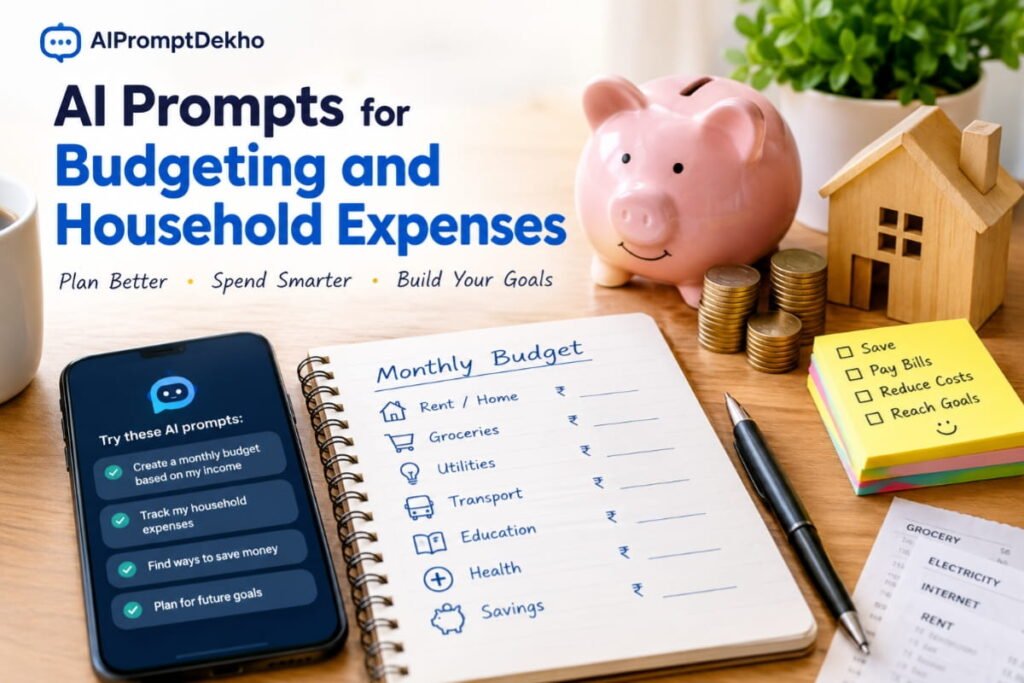
AI can help organize your financial information and compare everyday spending choices. It should be used as a planning assistant, not as a replacement for a qualified financial professional.
Prompt 21: Create a monthly household budget
“Act as a household budgeting assistant. My monthly take-home income is ₹[amount], and my regular expenses include [rent, groceries, transport, utilities, education, and other costs]. Create a monthly budget table with estimated amounts, totals, and remaining balance. Separate essential expenses, flexible spending, savings, and debt payments. If my expenses exceed my income, suggest realistic areas to review without assuming that every household has the same needs.”
Prompt 22: Find opportunities to reduce spending
“Review this monthly expense list: [paste categorized expenses]. Group the expenses into essential, discretionary, irregular, and unclear categories. Identify possible savings opportunities and estimate the effect of each change over one month and one year. Do not label essential medical, educational, or family expenses as unnecessary. State any assumptions and avoid double-counting expenses.”
Prompt 23: Plan a grocery budget
“Create a practical weekly grocery plan for a household of [number] people in [city or region]. My weekly budget is ₹[amount], and our dietary preferences are [preferences]. Use common, locally available ingredients and organize the plan into meals and a shopping list. Show estimated quantities and costs as estimates that I can verify against local prices. Ask about allergies or dietary restrictions if needed.”
Prompt 24: Compare two purchasing decisions
“Help me compare [product or option A] and [product or option B]. Their prices and relevant details are [details]. Calculate the total cost over [time period], including maintenance or recurring expenses if provided. Compare convenience, durability, and likely usage. Separate confirmed information from assumptions and explain which option fits my stated priorities better.”
Prompt 25: Create a savings goal
“Help me create a realistic savings plan for [goal]. My target amount is ₹[amount], my current savings are ₹[amount], and I can set aside approximately ₹[amount] each month. Calculate how long it may take to reach the target without assuming investment returns. Show monthly milestones and explain how I could adjust the timeline if my income or expenses change.”
Practical tip: Never paste bank passwords, UPI PINs, card security codes, or other sensitive credentials into an AI tool. Verify calculations and current financial terms independently.
6. AI Prompts for Everyday Productivity
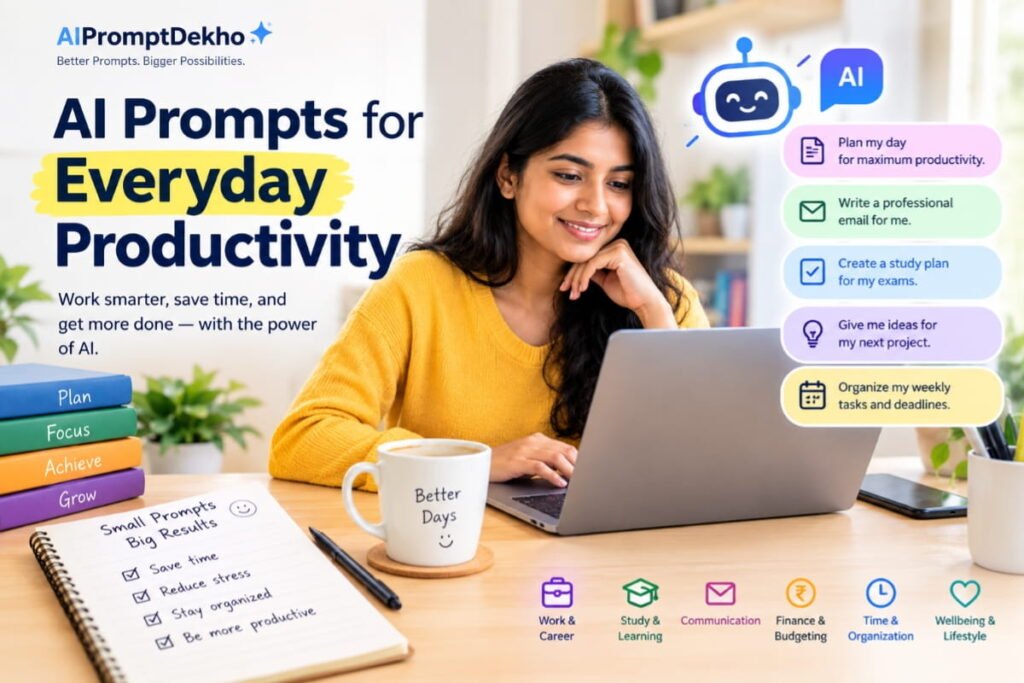
You can use AI to organize tasks, plan meals, prepare for trips, manage personal projects, and reduce the effort involved in routine writing.
Prompt 26: Plan your day realistically
“Act as my daily planning assistant. Here are my tasks: [task list]. My fixed commitments are [commitments], my available working hours are [hours], and my top three priorities are [priorities]. Organize my day into realistic time blocks, include breaks and travel time where relevant, and identify tasks that can be postponed or delegated. Do not schedule more work than my available time allows.”
Prompt 27: Prepare a travel itinerary
“Create a travel itinerary for [destination] from [starting city] for [number of days]. My approximate budget is ₹[amount], my travel dates are [dates], and my preferences are [food, sightseeing, nature, or family activities]. Include a suggested daily schedule, transport considerations, meal planning, and a contingency plan. Mark prices, opening hours, and transport details that need current verification.”
Prompt 28: Create a weekly meal plan
“Prepare a seven-day meal plan for [number] people. We prefer [vegetarian, non-vegetarian, or other preferences], our food budget is ₹[amount], and we usually have [available ingredients] at home. Suggest practical breakfasts, lunches, dinners, and a consolidated shopping list. Reuse ingredients to reduce waste and account for any dietary restrictions I provide.”
Prompt 29: Organize a personal project
“Act as a project planning assistant. I want to complete [project] by [deadline]. My available time is [hours per week], and the resources I have are [resources]. Break the project into milestones, tasks, estimated durations, dependencies, and weekly checkpoints. Identify likely obstacles and suggest backup plans. Ask clarifying questions if the project scope is too broad.”
Prompt 30: Write a polite message for a difficult situation
“Help me write a respectful message about [situation]. The recipient is [relationship or role], the outcome I want is [desired outcome], and the tone should be [friendly, formal, apologetic, or firm]. Provide three versions: short, balanced, and detailed. Keep the language natural, avoid unnecessary confrontation, and do not add promises or facts I have not provided.”
7. AI Prompts for Freelancers and Online Creators

Freelancers, bloggers, and digital creators can use AI to brainstorm ideas, plan projects, prepare proposals, and streamline content production.
Prompt 31: Find freelance services based on your skills
“Act as a freelance career coach. My current skills are [skills], my available time is [hours per week], and my preferred work is [type of work]. Suggest five realistic freelance services I could explore. For each service, identify a beginner-friendly portfolio project, the skills I need to strengthen, and a way to evaluate market demand. Do not promise earnings or assume that clients are guaranteed.”
Prompt 32: Write a freelance proposal
“Draft a personalized freelance proposal for this client requirement: [paste project brief]. My relevant skills and experience are [details], and my proposed approach is [approach]. Include an opening, understanding of the problem, scope, deliverables, questions for the client, and a professional closing. Do not invent client research, past results, or qualifications.”
Prompt 33: Create a blog outline
“Act as an experienced blog editor. Create a detailed outline for an article about [topic] aimed at [audience]. The article’s purpose is [purpose], and the primary search intent is [intent]. Suggest an informative title, introduction angle, logical H2 and H3 headings, examples to include, and questions the article should answer. Identify where original research or fact-checking is necessary. Avoid repetitive sections and unsupported SEO claims.”
Prompt 34: Turn one idea into multiple content formats
“Transform this original idea into a coordinated content package: [idea]. Create a blog outline, five social media posts, three short-video concepts, one newsletter outline, and a list of common audience questions. Keep the core message consistent but adapt the presentation to each format. Do not repeat the same paragraph everywhere. Identify factual claims that require verification.”
Prompt 35: Create a digital product idea
“Act as a digital product planning assistant. My skills are [skills], my target audience is [audience], and the problems I understand well are [problems]. Suggest five digital product concepts such as templates, worksheets, ebooks, or planners. For each, identify the customer problem, suggested contents, a low-cost prototype, and a simple way to validate demand before investing significant time or money.”
Practical tip: AI-generated content should be reviewed, fact-checked, and improved with your own expertise. Publishing large quantities of repetitive, unhelpful material can harm user trust and search performance.
8. AI Prompts for Technology and Digital Skills
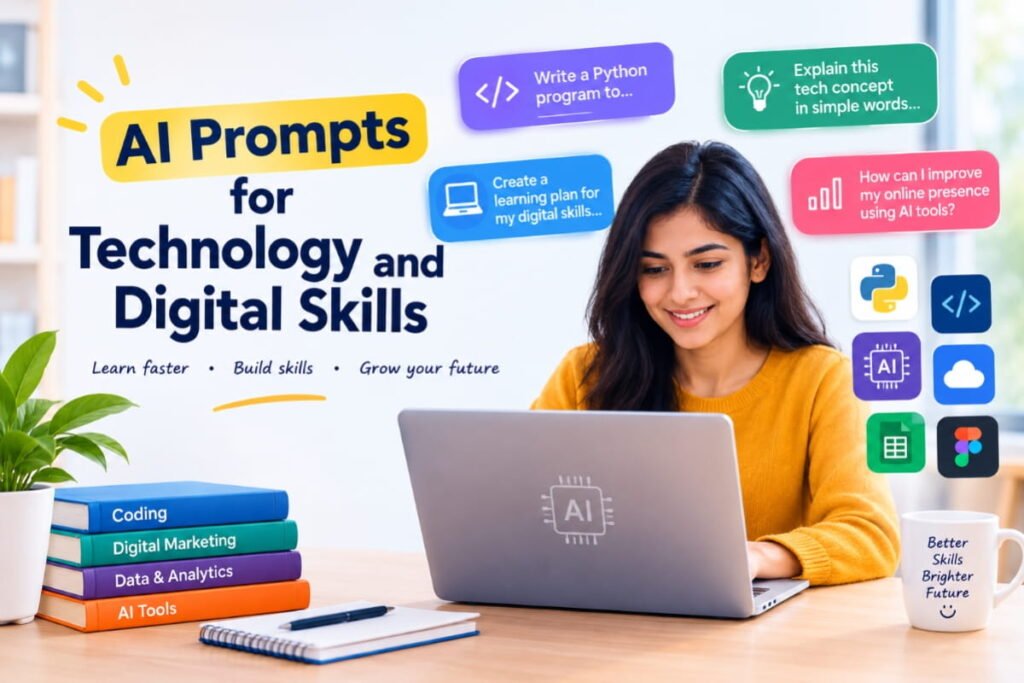
These prompts help people handle common technology tasks even when they are not technical experts.
Prompt 36: Understand an Excel formula
“Explain this Excel formula in simple language: [formula]. Describe what each function does, show a small example table, and explain what happens when cells are blank or contain unexpected values. If there is a simpler formula for the same task, suggest it and explain any differences.”
Prompt 37: Troubleshoot a website problem
“Act as a website troubleshooting assistant. I am using [platform, such as WordPress], and the problem is [describe the issue]. My recent changes were [changes], and the error message is [message]. Suggest safe diagnostic steps in order, explain what each step tests, and identify what information I should back up before making changes. Do not recommend destructive changes without explaining their risks.”
Prompt 38: Learn basic coding
“Teach me the basics of [programming language] as a beginner. My goal is to build [project], and I can study for [hours] per week. Create a learning roadmap with short lessons, simple examples, practice tasks, and mini-projects. Explain errors without assuming prior programming knowledge and include ways to test whether my code works.”
Prompt 39: Compare AI tools for a specific task
“Help me compare [AI tool A], [AI tool B], and [AI tool C] for [specific task]. My priorities are [cost, quality, privacy, language support, or ease of use]. Create a comparison framework and list the practical tests I should perform. Separate verified facts from features that require checking against current official documentation. Do not declare a winner without considering my priorities.”
Prompt 40: Summarize a long document
“Summarize the document I provide for [purpose]. Start with a concise overview, then list the main arguments, important figures, decisions, deadlines, and unresolved questions. Distinguish facts explicitly stated in the document from your interpretations. Include section references where possible, and do not fill missing information with guesses. Document: [paste text or provide an accessible file].”
Practical tip: Remove confidential business, customer, and personal information before uploading documents to an AI service unless you have permission and have checked the service’s privacy terms.
9. AI Prompts for Personal Learning and Better Decisions
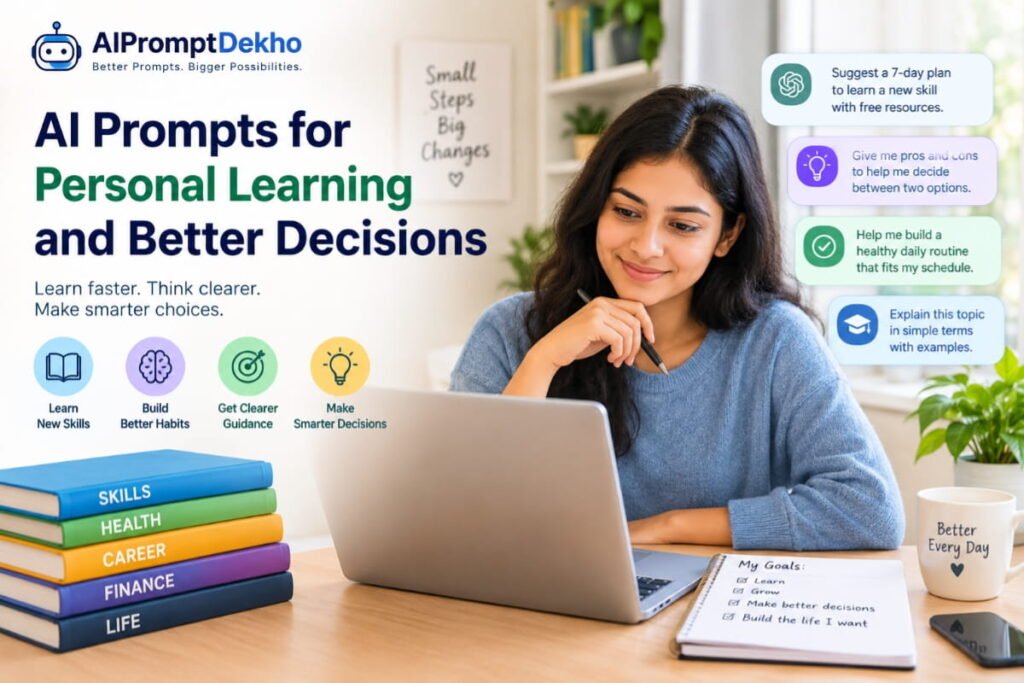
These prompts help readers reflect, compare options, and build useful habits without handing every decision over to AI.
Prompt 41: Learn a new skill in 30 days
“Help me learn [skill] over the next 30 days. My current level is [level], my goal is [goal], and I can practise for [minutes] per day. Create a weekly roadmap with daily exercises, practical projects, review days, and measurable milestones. Recommend free learning resources where possible and explain how I can assess my progress independently.”
Prompt 42: Compare career options
“Help me compare [career option A] and [career option B]. My education, skills, interests, financial constraints, and location preferences are [details]. Compare typical responsibilities, skills to develop, entry requirements, and questions to investigate. Separate general information from details that require current local research. Do not make assumptions about salaries or job availability.”
Prompt 43: Prepare questions before an important appointment
“Help me prepare for an appointment about [topic]. My main concerns are [concerns], and the outcome I want is [outcome]. Create a concise checklist of questions, documents to bring, and information I should clarify. Flag issues that may require advice from a qualified professional rather than making decisions on my behalf.”
Prompt 44: Make a household task-sharing plan
“Create a fair weekly household task-sharing plan for [number] people. The regular tasks are [tasks], each person’s availability is [availability], and any relevant constraints are [constraints]. Distribute the work realistically, include estimated time requirements, and suggest a simple review process to adjust the plan if it becomes unbalanced.”
Prompt 45: Break a difficult task into smaller steps
“I am struggling to start this task: [task]. My deadline is [deadline], and the main obstacle is [obstacle]. Break the task into steps that can each be completed in approximately [time] minutes. Identify the smallest useful first action, define what completion looks like, and suggest a way to track progress without making the plan unnecessarily complicated.”
10. AI Prompts for Local Communities and Specialized Needs
These final prompts cover needs that are particularly relevant to many Indian households, local organizations, and community-based businesses.
Prompt 46: Help plan a community event
“Help me organize a community event in [location] for approximately [number] people. The event’s purpose is [purpose], my budget is ₹[amount], and the proposed date is [date]. Create a checklist covering venue, permissions to investigate, accessibility, volunteers, supplies, communication, and contingency plans. Distinguish planning suggestions from legal or local requirements that need official confirmation.”
Prompt 47: Create a customer FAQ for a local service
“Create a customer FAQ for my [service or business] in [city]. My verified service details are [details], operating hours are [hours], prices or price ranges are [prices], and policies are [policies]. Write 15 clear questions and answers suitable for a website or WhatsApp Business profile. If important details are missing, list them for me to confirm rather than inventing answers.”
Prompt 48: Organize farming records
“Help me design a simple farm record-keeping template for [crop or farm type] in [region]. Include fields for planting dates, input expenses, labour, irrigation, observations, harvest quantities, and sales. Explain how to summarize costs and production over a season. Keep the template practical for a spreadsheet or notebook, and flag agronomic recommendations that need local expert verification.”
Prompt 49: Plan a low-budget family celebration
“Help me plan a family celebration for [occasion] in [city or town]. My budget is ₹[amount], the expected number of guests is [number], and our preferences are [food, activities, and venue]. Create a cost breakdown, preparation timeline, shopping list, and backup plan. Use estimated costs only where current prices are unavailable, and suggest ways to avoid waste.”
Prompt 50: Find practical ways to use AI every week
“Act as my personal AI productivity coach. My daily responsibilities are [responsibilities], the repetitive tasks I dislike are [tasks], and the AI tools I can access are [tools]. Suggest 10 realistic ways AI could help me save time or improve the quality of my work. For each idea, provide an example prompt, the information I would need to supply, possible limitations, and a simple way to evaluate whether it is genuinely useful.”
11. How to Get Better Results From These AI Prompts
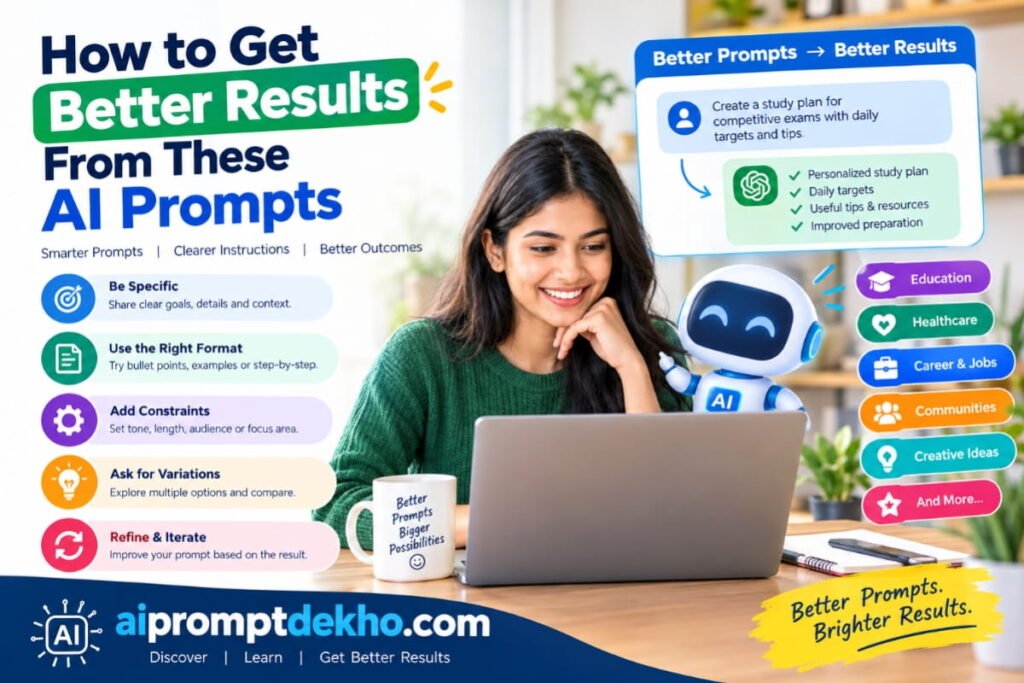
Copying a prompt is only the first step. A few simple habits can make the results more relevant.
1. Replace placeholders with specific details. Instead of saying “make a budget,” provide your income, expense categories, household size, and goals.
2. Tell the AI about your constraints. Mention your available time, budget, preferred language, skill level, and location when relevant.
3. Request a useful output format. Ask for a table, checklist, timetable, sample email, or step-by-step plan rather than a vague explanation.
4. Improve the first answer. Follow up with instructions such as “make this simpler,” “show another example,” or “adjust this for a beginner with a limited budget.”
5. Verify important information. AI can make mistakes, misunderstand context, or provide outdated information. Verify official notifications, prices, eligibility requirements, financial calculations, and other consequential details.
6. Protect your privacy. Do not enter passwords, payment credentials, confidential customer data, or unnecessary personal information into AI tools.
7. Test different tools. The same prompt can produce different results in ChatGPT, Gemini, Claude, and other systems. Compare the outputs for your actual task instead of assuming that one tool is always best.
Frequently Asked Questions
1. What are the best AI prompts for everyday life in India?
Useful prompts include those for job applications, English practice, competitive exam preparation, household budgeting, small business marketing, meal planning, and daily productivity. The best prompt is the one that addresses your actual problem and gives you an actionable result.
2. Can I use these prompts with free AI tools?
Yes. You can try these prompts with free versions of AI assistants such as ChatGPT and Gemini, subject to each service’s current access limits and features. Some advanced tools or capabilities may require a paid plan.
3. Can AI prompts help students prepare for government exams?
AI can help create study schedules, explain concepts, and generate practice questions. However, students should verify exam information and study against the official syllabus and reliable learning materials.
4. Can AI help me find a job in India?
AI can help improve resumes, draft cover letters, identify skill gaps, and practise interviews. It cannot guarantee employment or ensure that a vacancy is genuine. Always verify employers and job listings independently.
5. How can small businesses use AI prompts?
Small businesses can use AI to draft product descriptions, create social media calendars, respond to common customer questions, plan seasonal campaigns, and organize routine operations. All public-facing content should be checked for accuracy.
6. Do I need to know coding to use AI prompts?
No. Most prompts in this guide can be used without coding knowledge. Clear instructions and relevant context are usually more important than technical expertise.
7. Are AI-generated answers always correct?
No. AI systems can generate incorrect, incomplete, or outdated information. Check important facts using reliable sources, particularly for financial, legal, medical, educational, and career decisions.
8. How can I save my favourite AI prompts?
Store useful prompts in a document, spreadsheet, or personal prompt library. Organize them by task, tool, and purpose, and save examples of successful outputs so you can improve them over time.
Conclusion
AI does not need to be complicated to be useful. A well-written prompt can help you prepare for an interview, practise English, organize your expenses, support a small business, or plan your next learning project.
Start by choosing one real problem from your daily life. Copy the relevant prompt from this guide, replace the placeholders with your own details, and evaluate the result. If the answer is not useful, refine your instructions and try again.
Bookmark AIPromptDekho.com for practical AI prompts, tutorials, and ideas that help you use artificial intelligence more effectively in everyday life.